In Section A and Question 5 of the Edexcel exam, you must immediately distinguish physical acoustic vibrations from synthetic tones: the Mellotron's tape warble and flutter, the Rhodes' bell-like tine chime, the Wurlitzer's reed bark and vibrato, the Clavinet's sharp guitar staccato, the Hammond's rotary Doppler whirl, and the Solina's lush triple-chorus string sweep.
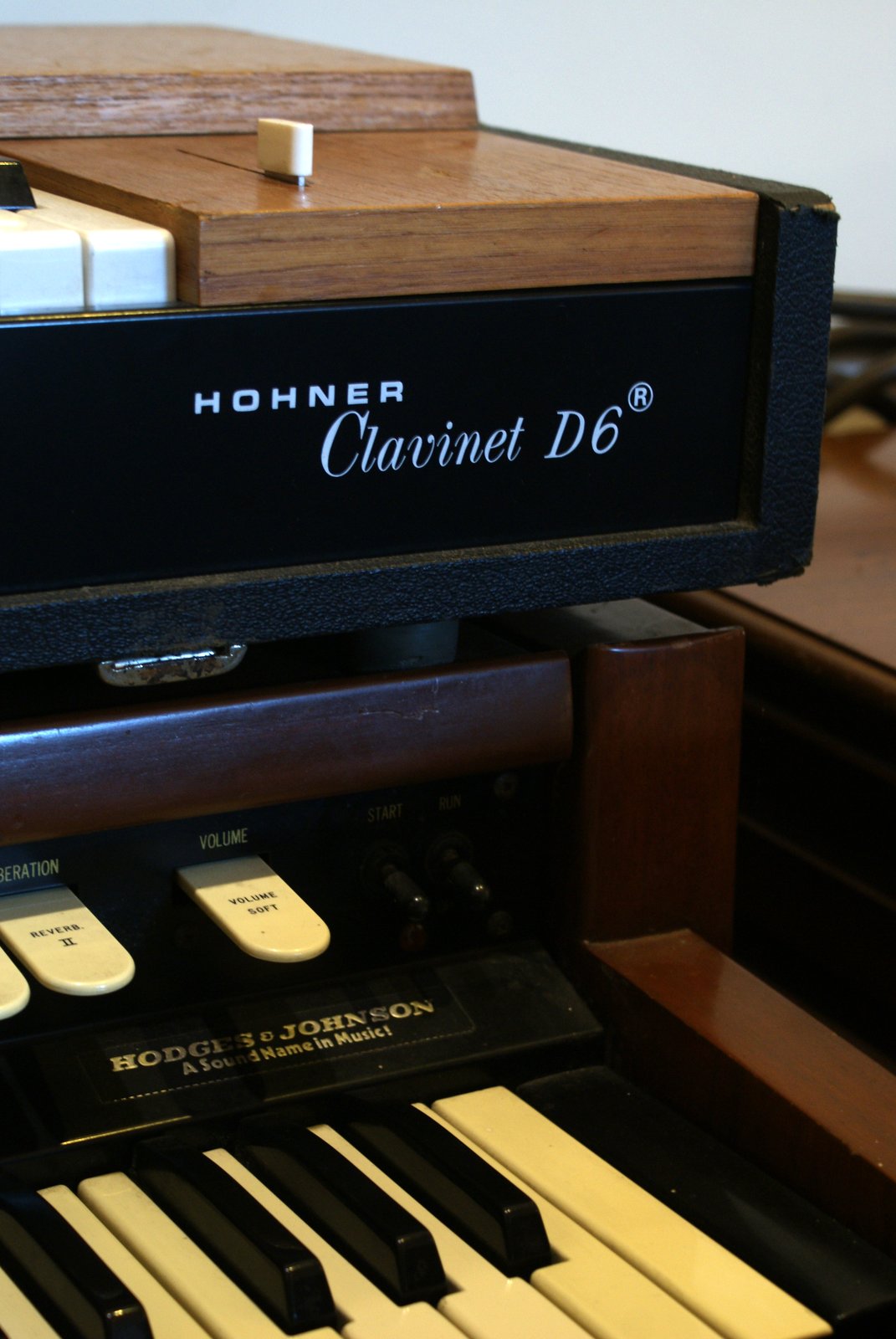
Acoustic grand pianos were impossible to amplify on loud rock and soul stages without acoustic feedback. Between 1934 and 1974, engineers invented ingenious electro-mechanical, electrostatic, tape-replay, and analog divide-down solutions that became the core timbres of modern popular music.
- 1Electromagnetic Induction (Rhodes, Clavinet, Hammond): A ferric metal object moves through a permanent magnetic field, inducing an electrical current in a copper wire coil (Faraday's Law).
- 2Electrostatic / Capacitive (Wurlitzer): A vibrating metal reed changes the air gap distance to a charged plate, altering electrical capacitance (C = ε · A / d) powered by 170V DC.
- 3Analog Tape Replay (Mellotron): Keys drag real multi-track magnetic tapes across electromagnetic playback heads for 8 seconds per key.
- 4Divide-Down & Triple BBD Chorus (Solina): A master clock chip feeds frequency dividers to produce 49-note polyphonic sawtooth waves animated by bucket-brigade analog delay modulation.
Listen at 0:45 when Herbie Hancock enters on the Fender Rhodes Mark I. Notice the round, bell-like fundamental chime when played softly, transitioning into a biting, distorted harmonic bark when hit aggressively. The Rhodes sits smoothly in the midrange without masking the ARP Odyssey synth bassline underneath.
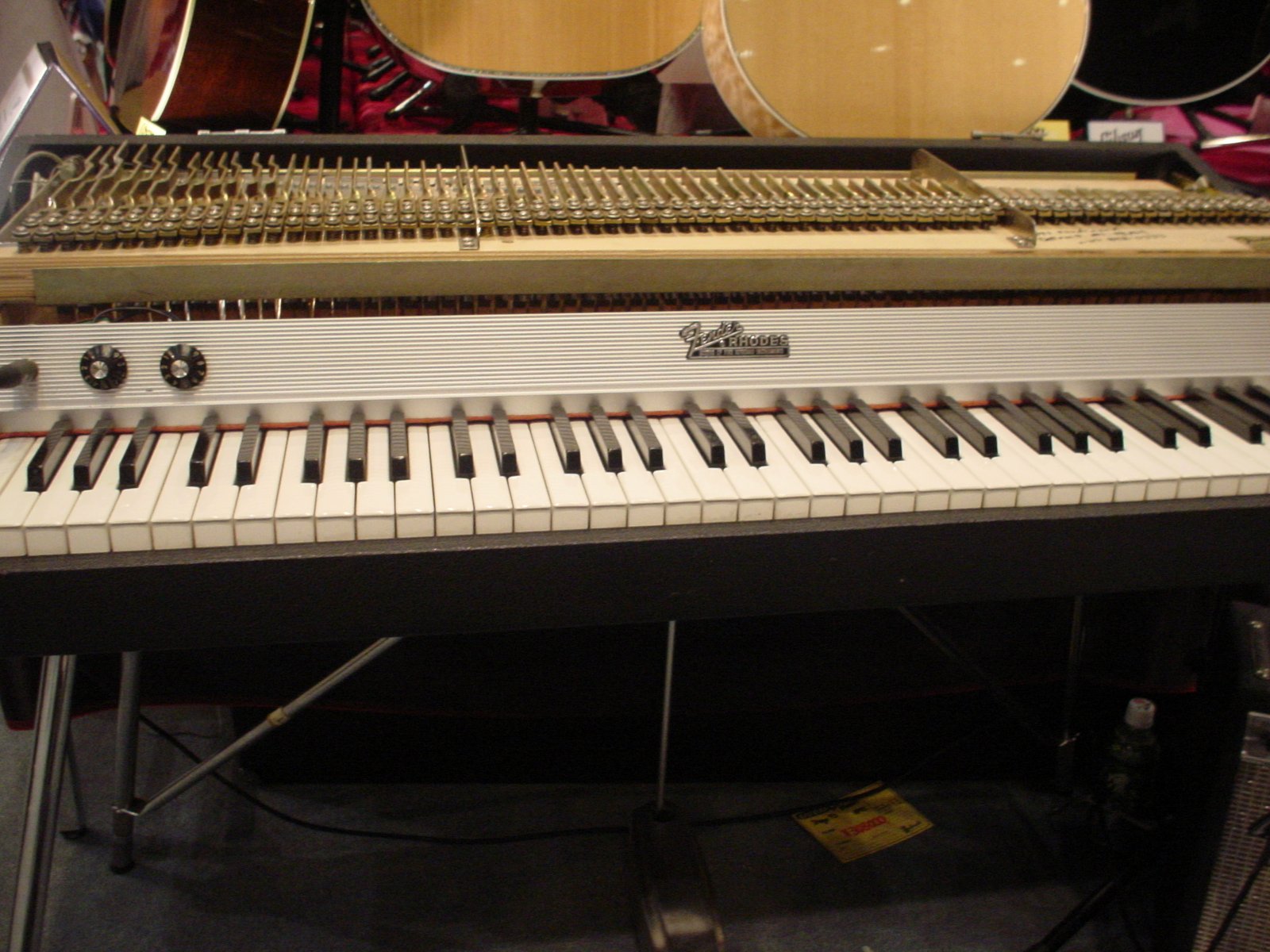
Invented in 1942 by Harold Rhodes as the "Army Air Corps Convalescent Piano," built from discarded B-17 airplane hydraulic tubes so wounded soldiers could play music in bed. Leo Fender partnered with Rhodes in 1959. Following the CBS acquisition, the definitive Rhodes Mark I Stage and Suitcase (1969–1975) swept the globe.
- 1Rubber Hammer Striking Action: Pressing a weighted wooden key throws a pivoted neoprene rubber hammer tip upward.
- 2Asymmetrical Tuning Fork: The hammer strikes a tapered steel wire called a tine. The tine is rigidly joined to a heavy, tuned steel resonator block called a tonebar. Together they form an asymmetrical tuning fork that sustains for over 20 seconds.
- 3Electromagnetic Pickup Transduction: Positioned millimeters from the tip of each tine is an individual electromagnetic pickup (copper wire coiled around an Alnico cylinder magnet). The vibrating ferric tine disturbs the magnetic field, generating an alternating audio voltage.
Ray Manzarek's intro captures rainfall through high-register Rhodes arpeggios. Notice the built-in Suitcase auto-pan optical tremolo gently oscillating the audio signal between the left and right stereo speakers. The clean, pure bell resonance floats over Jim Morrison's whisper vocal.
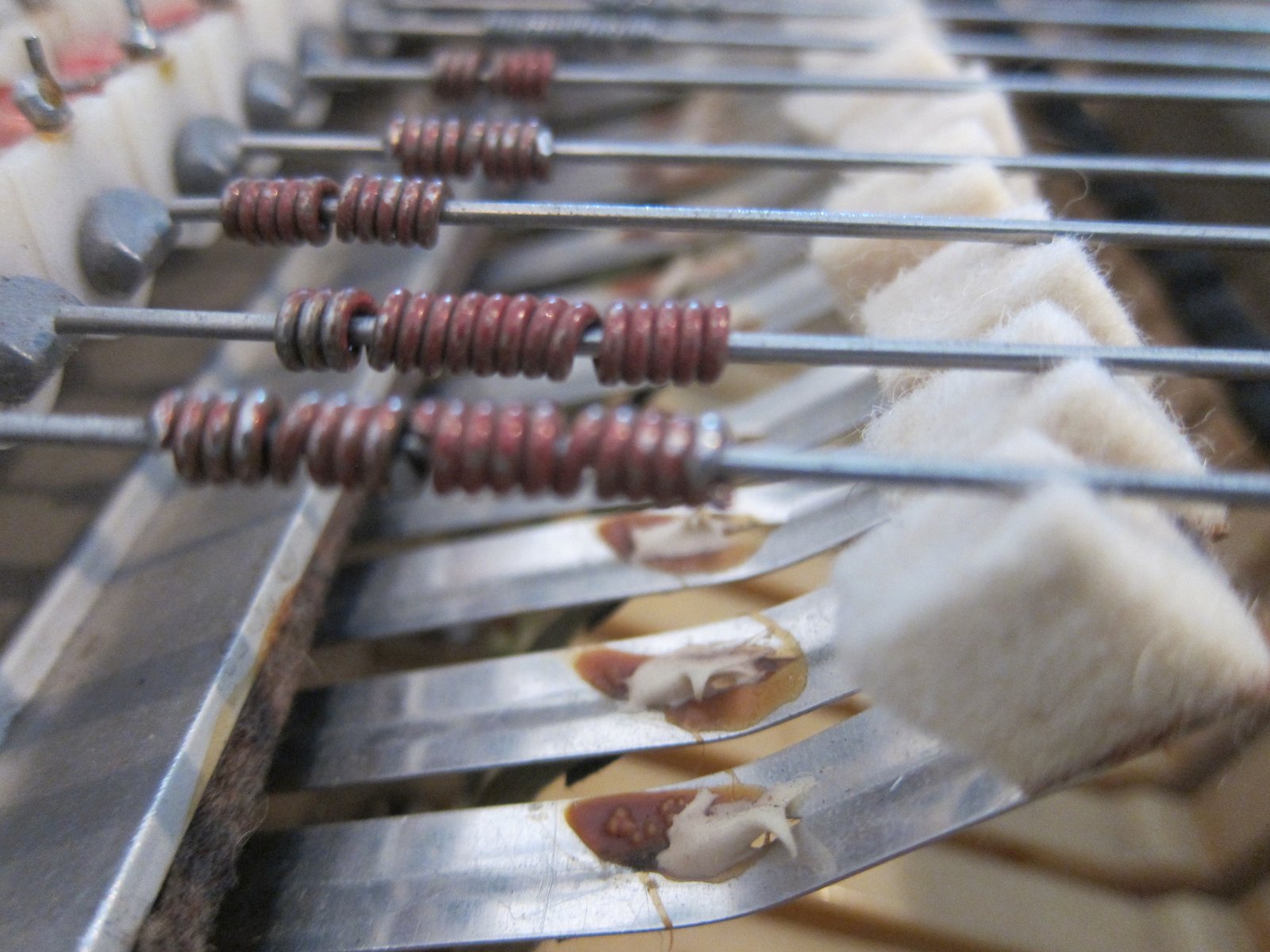
The Stage 73/88 had four detachable chrome legs and passive volume/bass controls requiring external guitar amps (e.g., Fender Twin Reverb). The Suitcase Piano sat on a dedicated 4x12" powered speaker cabinet containing an active stereo preamp with an optical LDR (light-dependent resistor) stereo auto-pan circuit.
- 1Tine Height Alignment: Adjusting the tine tip directly in line with the magnetic pickup pole produces a rich, distorted, harmonic-heavy tone. Moving it slightly above produces a pure, glassy fundamental sine-wave tone.
- 2Pickup Distance (Volume & Bark): Moving the pickup closer to the tine increases output volume and dynamic punch; moving it farther reduces percussive attack.
- 3Tuning Spring: A tiny, tightly wound steel spring slid along the tine alters its vibrating mass, allowing fine microtonal tuning without retuning strings.
Stevie Wonder recorded eight multi-tracked layers of the Hohner Clavinet D6, panning them across the stereo field to create a massive polyrhythmic web. Notice the ultra-fast percussive attack, total absence of sustain, and the metallic "twang" that sounds more like an electric guitar than a keyboard.
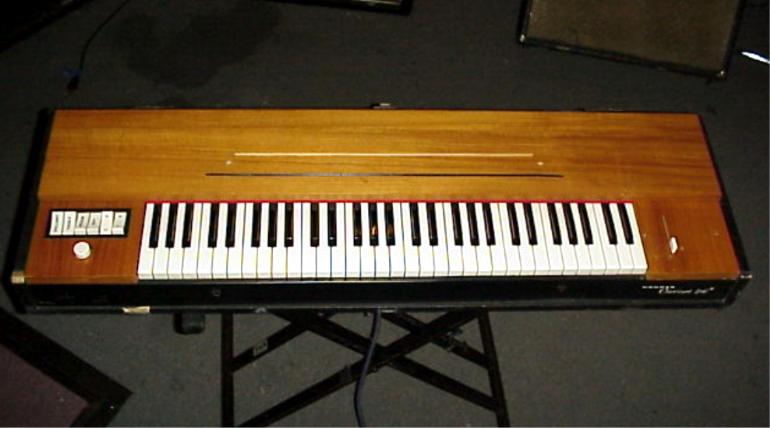
Invented in 1964 by Ernst Zacharias for Hohner in Trossingen, Germany. Designed as an electrified European clavichord to let musicians quietly practice Renaissance and Baroque classical literature (like J.S. Bach) at home. Soul and funk musicians completely hijacked it into a percussive rhythm machine.
- 1Rubber Tangent Striking: Underneath each key sits a small, replaceable rubber tip (tangent). Pressing the key drives the rubber tangent directly down onto a real steel electric guitar string.
- 2Metal Anvil Fretting: The tangent traps the string firmly against a precision metal anvil fret. The string vibrates between the anvil and the bridge, setting the exact musical pitch.
- 3Yarn Damper Choking: A piece of woven wool yarn is threaded through the dead end of all 60 strings. The instant the key is released, the string touches the yarn and immediately stops vibrating, providing instantaneous staccato cut-off.
- 4Twin Electromagnetic Pickups: Two single-coil guitar pickups (Neck and Bridge) sense the string vibration.
John Paul Jones drives the song's driving riff on a Hohner Clavinet D6 fed through an MXR Phase 90 and a Crybaby Wah-Wah pedal. The wah pedal sweeps the resonant bandpass peak, mimicking a heavily distorted funk guitar riff while locking tightly with John Bonham's kick drum.
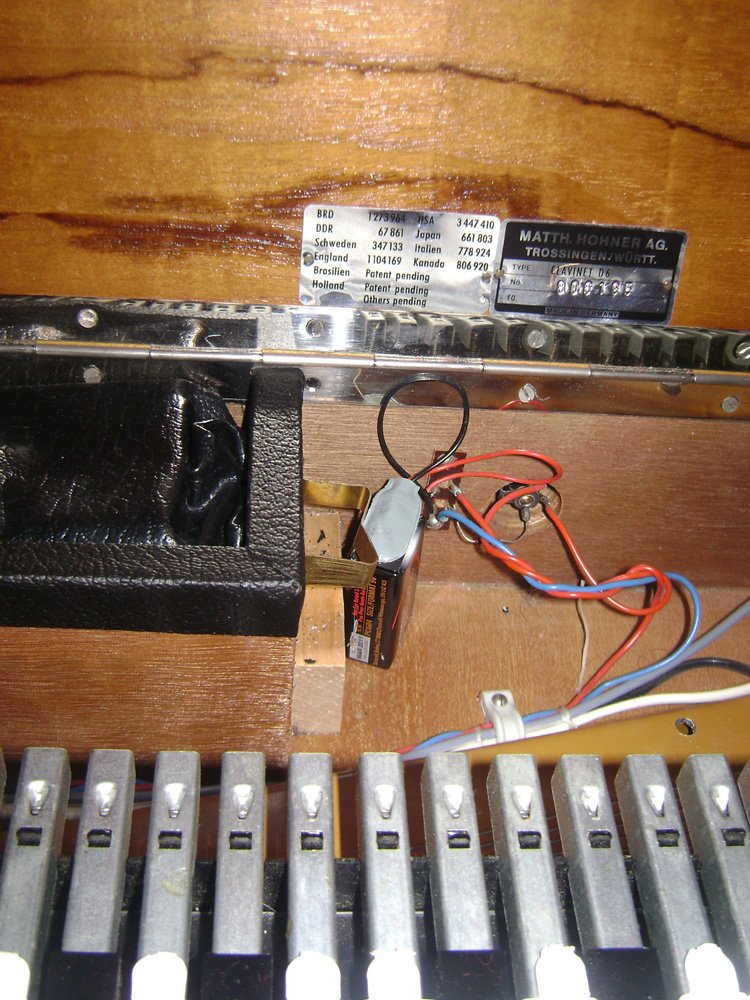
The Clavinet D6 features four passive EQ filter rocker switches on the left cheek block: Brilliant (high-pass filter), Treble (mids boost), Medium (mids cut), and Soft (treble attenuation). Right-side switches (A/B and C/D) select Neck pickup, Bridge pickup, both in-phase, or out-of-phase (thin, hollow strat-like tone).
- 1Sliding Felt Bar: Located beside the lowest keys is a mechanical lever that moves a bar of thick felt against the strings near the bridge.
- 2Acoustic Damping: Engaging the mute dampens fundamental resonance, transforming the sound into a hyper-dry, banjo- or kalimba-like wooden click.
- 3External FX Pairing: Because its output impedance matches an electric guitar, it plugs directly into guitar stompboxes (Envelope Filters / Mu-Tron III, Distortion, Wah-wah).
Paul McCartney's immortal intro is performed on a Mellotron Mk II using the Flutes tape frame. Listen for the subtle acoustic breath sounds, slight pitch instability, room ambience, and the gentle mechanical tape flutter. It gave The Beatles an entire acoustic orchestra inside Abbey Road Studio Two.
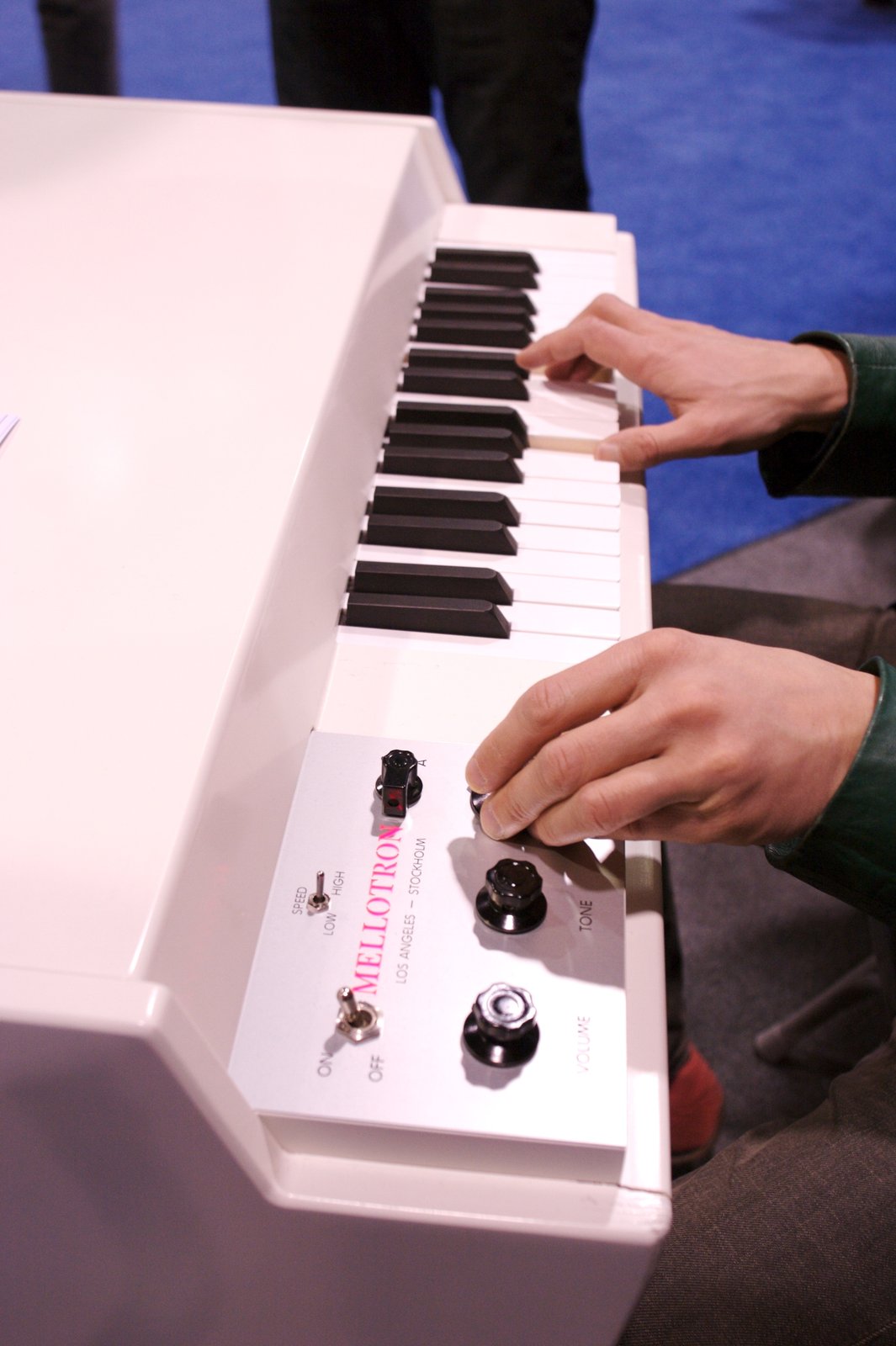
Invented by Harry Chamberlin in California in 1949. In 1962, salesman Bill Fransen took two Chamberlins to Birmingham, England. Les, Frank, and Norman Bradley (Streetly Electronics) redesigned the mechanical tape-return mechanism, releasing the twin-keyboard Mellotron Mk II (1964) and the touring M400 (1970).
- 1Individual Magnetic Tape Strips: Inside the cabinet, every single key has its own individual 3/8-inch analog magnetic audio tape running through a spring-loaded pulley system.
- 2Pinch Roller & Capstan Drive: A master electric motor continuously spins a long steel drive shaft (capstan). When a key is pressed, a rubber pinch roller clamps the tape against the spinning capstan, pulling it forward.
- 3Audio Playback Head: Simultaneously, a spring-loaded felt pad pushes the magnetic tape directly against an audio tape replay head, playing the real recorded note.
- 48-Second Time Limit: Each tape strip is physically 6 feet long, yielding a maximum sustain of exactly 8 seconds. On key release, a return spring snaps the tape back to the start.
Mike Pinder, who previously worked as a quality control tester at Streetly Electronics, layered soaring Mellotron 3-Violins over acoustic guitar and orchestral percussion. Notice how the strings possess a dramatic vibrato recorded directly from real violinists, along with the distinct low-frequency motor hum and tape hiss.
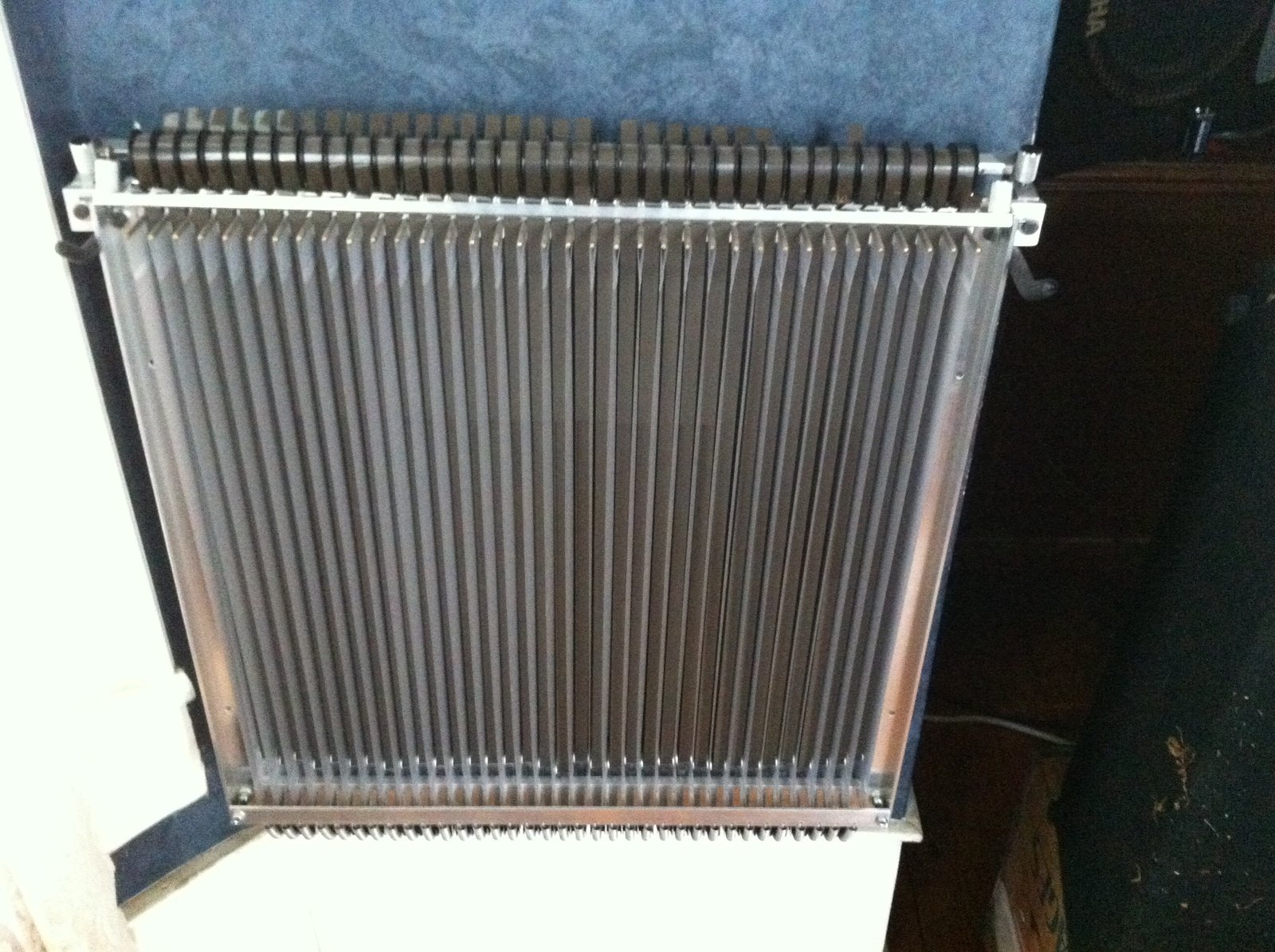
Each 3/8" tape strip had three audio tracks recorded side-by-side (Track A: 3 Violins, Track B: Flutes, Track C: Cello). A track-selector lever physically shifted the playback heads laterally between tracks. On the portable Mellotron M400 (1970), the entire 35-tape frame could be unbolted and swapped out in minutes for choir or brass tapes.
- 1Motor Drag & Wow: Playing a massive 10-finger chord pulled 10 rubber pinch rollers against the motor capstan simultaneously, creating friction that slowed down the motor and caused pitch drops (wow and flutter).
- 2Pitch Variation Knob: A front-panel DC servo motor speed control allowed players to adjust playback speed for microtonal bends and tape slowing effects.
- 38-Second Re-Triggering: Keyboardists had to develop a rolling "spider-fingering" technique, releasing and re-striking keys every 7 seconds so the tape wouldn't run out abruptly.
Notice the biting, hollow, reed-like mid-range stabs of the Wurlitzer 200A driving the intro. Unlike the mellow bell chime of the Rhodes, the Wurlitzer cuts sharply through dense drums and brass with a tight, honky, aggressive transient and subtle optical tremolo.
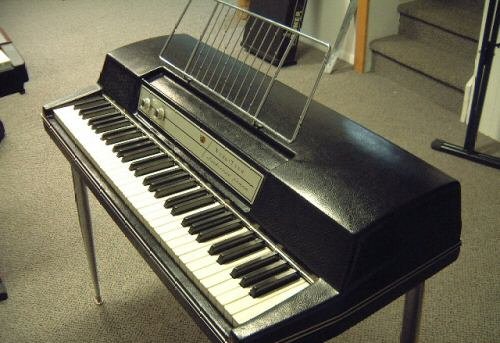
Invented in the 1930s by inventor Benjamin Miessner and manufactured by the Rudolph Wurlitzer Company from 1954 to 1984. Starting with the wooden-cabinet Model 112 (1954) made famous by Ray Charles, it culminated in the iconic molded plastic-top Model 200 and 200A (1968–1980).
- 1Felt Piano Hammer: A miniature grand piano wooden action throws a felt-covered hammer upward against a tuned flat Swedish steel reed.
- 2Electrostatic Comb Plate: The reed vibrates inside a precision metal pickup comb with an air gap of less than 1 millimeter.
- 3High-Voltage DC Polarization: A 170V DC polarizing voltage is applied between the reed and the pickup comb, forming an electrical capacitor.
- 4Capacitive Modulation: As the steel reed vibrates, the distance (d) changes, modulating capacitance (C = ε · A / d) and converting physical vibrations into an electrical audio signal.
Bassist John Deacon composed this track on a Wurlitzer 200, running it into an overdriven tube amplifier. Notice the aggressive harmonic saturation when playing hard chords, combined with the signature pulsing onboard optical tremolo circuit oscillating the audio amplitude.
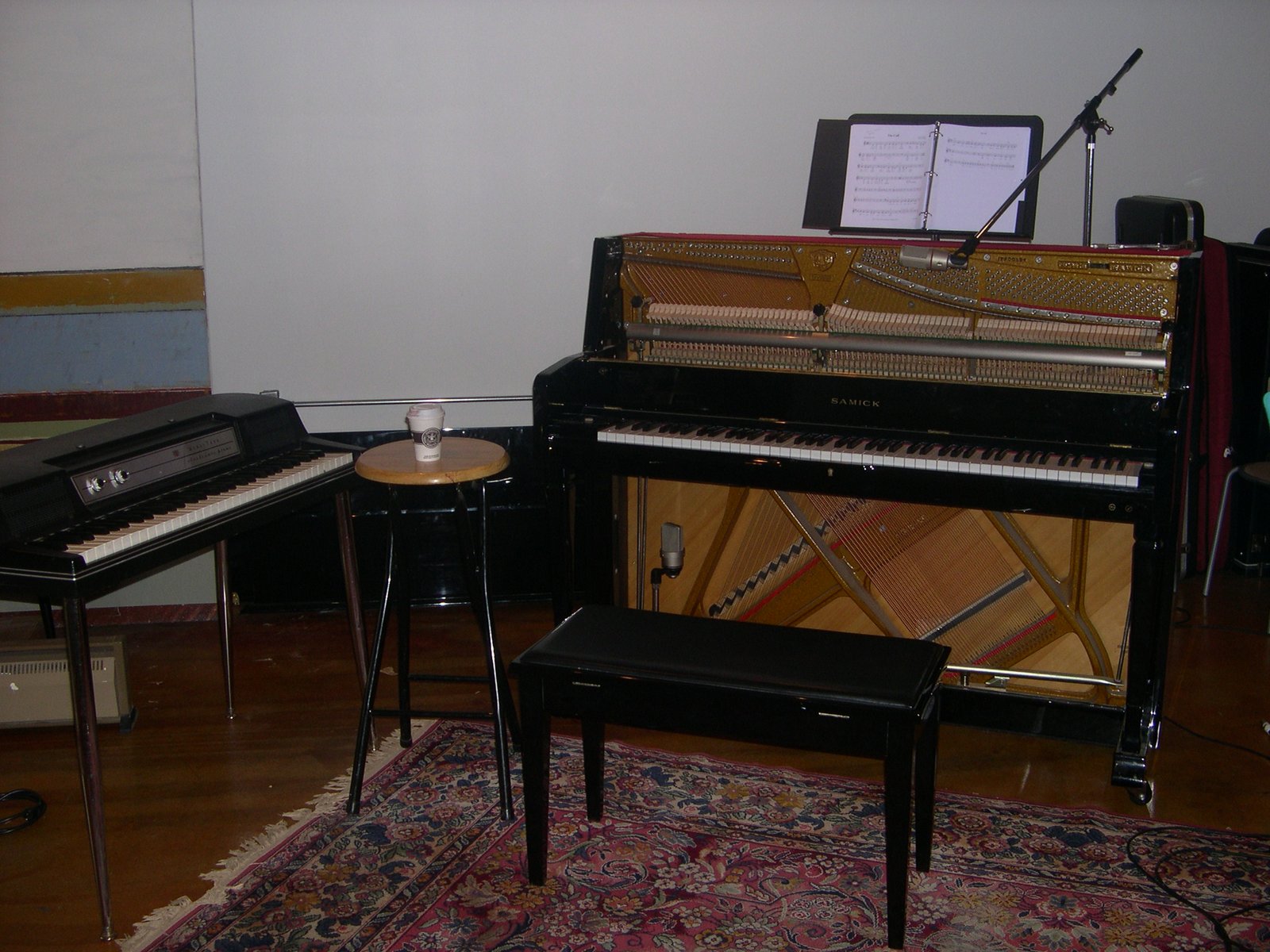
The famous Wurlitzer "vibrato" knob does not change pitch; it is an amplitude tremolo. A low-frequency oscillator flashes a small neon bulb against a light-dependent resistor (LDR), periodically shunting the audio signal to ground at roughly 6 Hz to create a hypnotic, pulsing wave.
- 1Sound Element: Rhodes = Tapered steel tine + heavy resonant tonebar. Wurlitzer = Flat, tuned steel reed.
- 2Pickup Method: Rhodes = Electromagnetic induction (copper coils/magnets). Wurlitzer = Electrostatic capacitive (polarized charged plate).
- 3Harmonic Profile: Rhodes = Mellow, bell-like, round low-end sine fundamental. Wurlitzer = Biting, mid-focused, nasal reed timbre with aggressive harmonic breakup.
Booker T. Jones set the drawbars to 888000000 (first three drawbars fully out for massive fundamental sub-warmth). Notice the signature percussive key click at the front of every note, followed by warm, continuous sustain with zero decay, anchored by Steve Cropper's guitar.
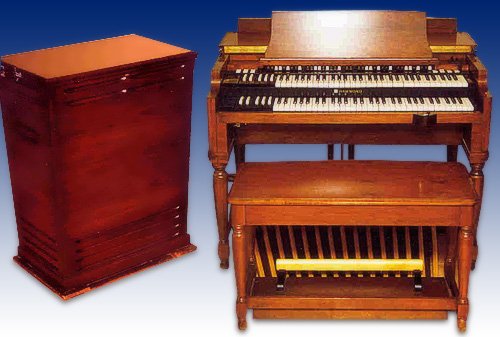
Patented in 1934 by Laurens Hammond and John M. Hanert in Evanston, Illinois. Hammond was an engineer building synchronous electric clocks; he adapted the precision clock motor to rotate sound-generating steel gears. Originally marketed to churches as a low-cost, compact substitute for pipe organs.
- 1Synchronous Electric Motor: A master synchronous motor turns a central drive shaft at exactly 1200 RPM, spinning 91 scalloped steel tonewheels.
- 2Magnetic Pickup Induction: Each tonewheel has scalloped teeth along its edge. As teeth pass a permanent magnet wrapped in copper wire, the fluctuating magnetic reluctance induces a pure sine-wave current.
- 3Drawbar Additive Synthesis: 9 sliding drawbars colored white, black, and brown represent pipe organ footages (16′, 5⅓′, 8′, 4′, 2⅔′, 2′, 1⅗′, 1⅓′, 1′). Pulling drawbars out (0 to 8) adds harmonic overtones additively.
- 4Mechanical Key Click: Beneath each key are 9 spring contacts that hit busbars, creating an iconic, unpitched percussive click.
Matthew Fisher's iconic Bach-inspired organ line demonstrates the magic of the Leslie 122 rotary cabinet. Notice the slow, undulating Chorale mode (~40 RPM) creating gentle acoustic room swirl, accelerating into rapid Tremolo mode (~400 RPM) for dramatic, shimmering emotional climaxes.
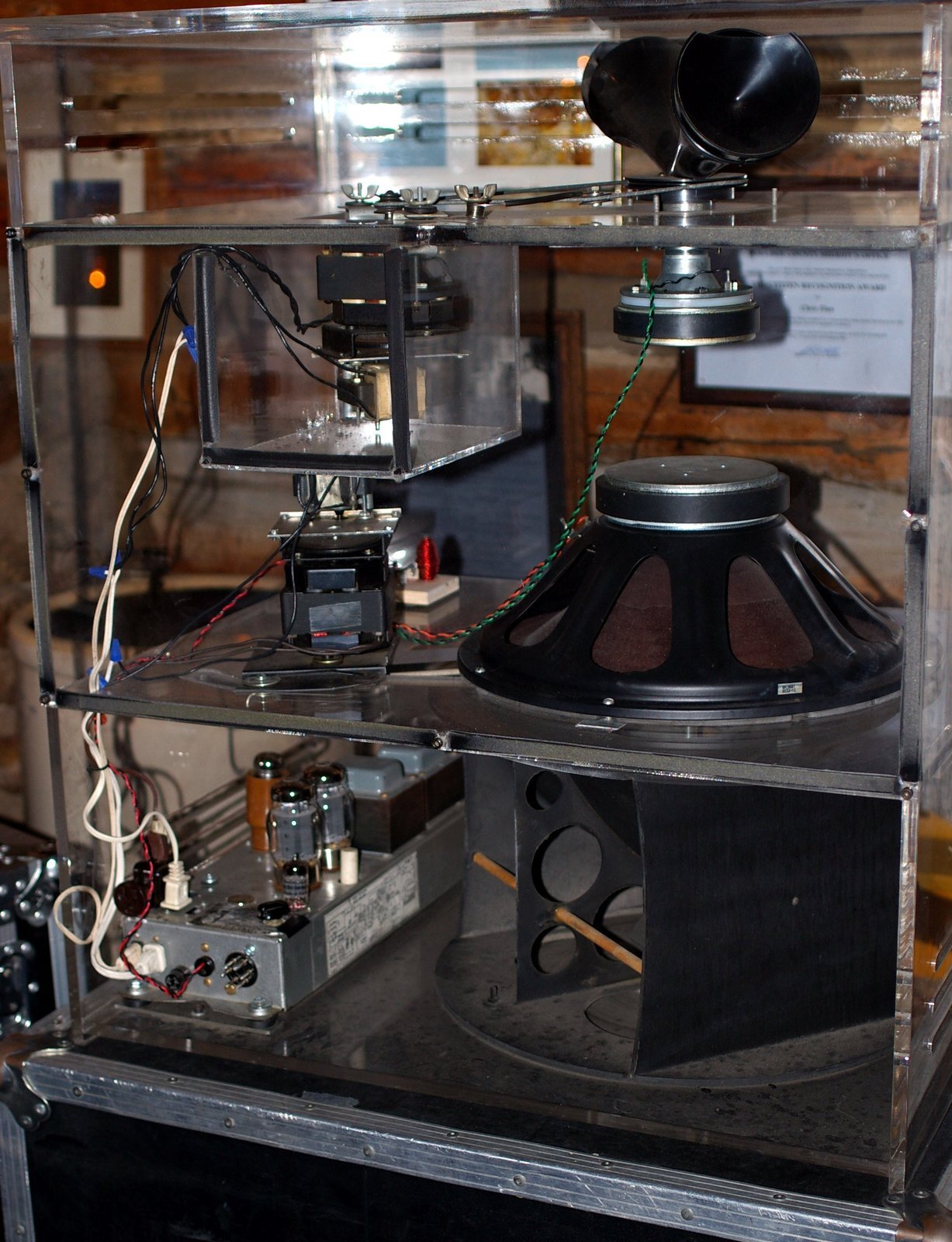
Invented in 1940 by Donald Leslie. Laurens Hammond famously hated the Leslie cabinet because it altered his organ's pure church pipe organ sound; he even banned Hammond dealers from selling them. Musicians ignored him, making the Hammond B3 + Leslie 122/147 the ultimate sonic pairing in music history.
- 1Treble Horn & Bass Drum: A crossover network (800 Hz) sends highs to a rotating dual-horn compression driver at the top, and lows to a stationary 15" woofer firing into a rotating wooden drum rotor at the bottom.
- 2Opposite Rotation: The horn and drum rotate in opposite directions driven by independent two-speed electric motors.
- 3Doppler Pitch Shift: As the horn spins towards the listener, pitch shifts sharp; spinning away, pitch shifts flat.
- 4Amplitude Modulation & Reflections: The spinning horn points sound in and out of the room, creating an immersive physical combination of vibrato, tremolo, and room acoustic reflections.
Richard Wright lays down the legendary intro pad on the Solina String Ensemble (ARP String Ensemble) run through an Electro-Harmonix Small Stone phase shifter. Notice the lush, glassy, animated string texture that sounds like 16 violins playing simultaneously with lush, swirling phase sweeps.
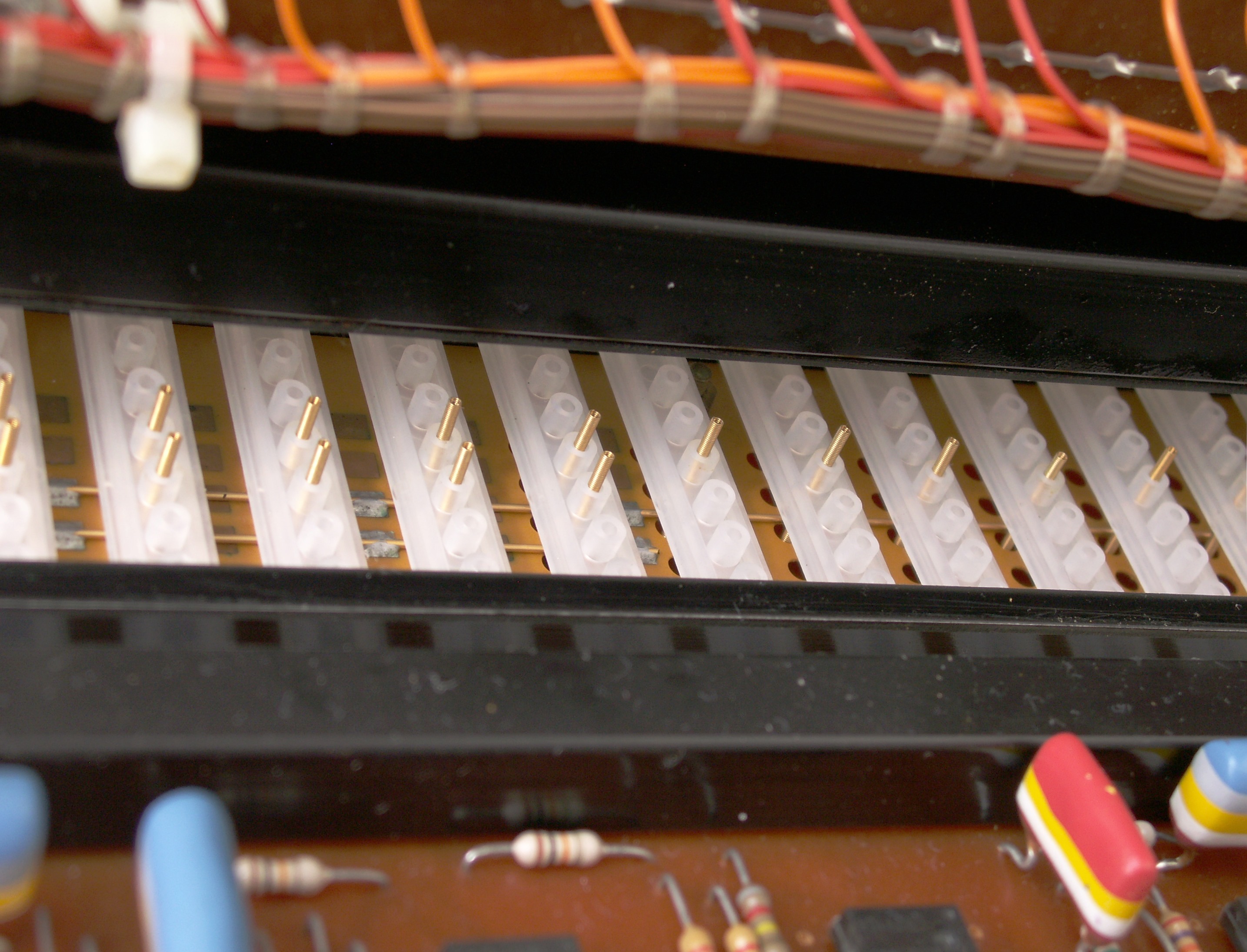
Invented in 1974 by Eminent BV in Bodegraven, Netherlands. Organ technician Ken Freeman pioneered the "string chorus" concept. Eminent packaged the string section of their 310 Unique organ into a standalone 49-key portable keyboard: the Solina String Ensemble. ARP Instruments licensed it as the ARP String Ensemble, selling thousands to disco and rock icons.
- 1Top Octave Synthesizer (TOS): A master high-frequency clock oscillator feeds a Mostek MK50240 chip, generating the top 12 semi-tone pitches of the highest octave.
- 2Binary Frequency Dividers: Flip-flop divider chips divide frequencies by two repeatedly to produce all lower octaves. This provides full 49-key polyphony using raw sawtooth waves.
- 3Formant Bandpass Filters: Passive filter networks shape raw sawtooth waves into Violin, Viola, Trumpet, Horn, Cello, and Contra-bass voices with paraphonic envelope attack and sustain.
- 4The Triple BBD Chorus Engine: The dry sawtooth signal is split into three Bucket Brigade Device (BBD) analog delay lines (TCA350 chips). Two independent LFOs (0.6 Hz and 6 Hz) modulate the delays with 120° phase offsets, transforming thin buzz into rich acoustic string beating.
Producer Martin Hannett recorded Bernard Sumner's ARP/Solina String Ensemble playing the iconic high counter-melody above Peter Hook's chorus bassline. Listen for the distinct high-register "violin" bite, the constant chorused shimmering, and how the sustain pedal allows long, mournful notes to linger over the drum machine.
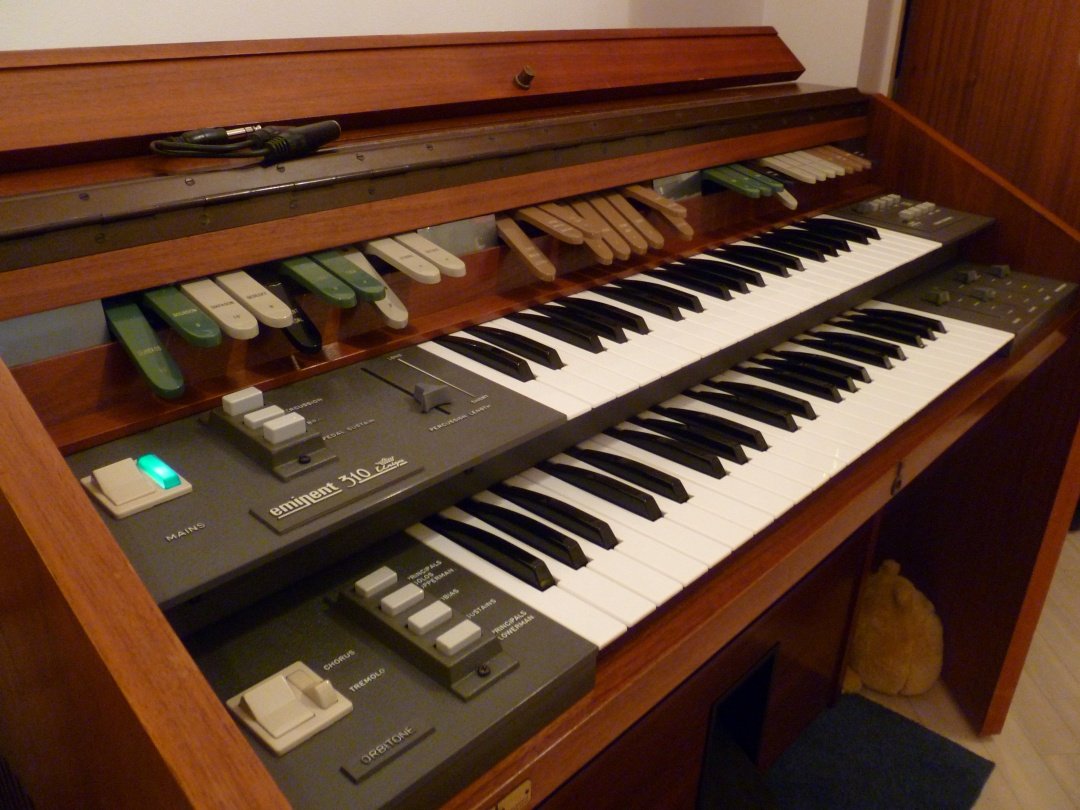
While the Solina has fully polyphonic pitch generation (you can hold down all 49 keys at once without notes dropping out), it has a paraphonic envelope. All voices pass through a single, shared VCA envelope filter. If you hold down a chord and press a new note, the attack envelope does not re-trigger independently.
- 1Upper Register Voices: Violin and Viola (sharp, piercing, bandpass-filtered sawtooths that cut through dense guitar mixes).
- 2Lower Register Voices: Cello and Contra-Bass (low-pass filtered sawtooths with rich, warm sub-bass undertones).
- 3Brass Formant Voices: Trumpet and Horn (filtered with distinct resonant mid-range humps).
- 4Ensemble ON/OFF Button: Switching the ensemble chorus OFF exposes the dry, buzzy, organ-like sawtooth waves, proving the BBD chorus circuit creates 90% of the instrument's character.
Jean-Michel Jarre paired the Solina String Ensemble with an Electro-Harmonix Small Stone phaser and tape echo to create the iconic swooshing pad of ambient electronic music. Notice how the triple BBD chorus interacts with the 4-stage phase shifter to create a living, breathing soundscape.
| Instrument | Sound Source | Transducer Method | Sonic Character |
|---|---|---|---|
| Fender Rhodes | Neoprene hammer strikes steel tine + tonebar | Electromagnetic induction pickups | Bell-like chime, round warm fundamental, velocity bark |
| Hohner Clavinet | Rubber tangent strikes steel guitar string onto anvil | Twin single-coil electromagnetic pickups | Sharp, biting, percussive staccato, zero sustain, guitar twang |
| The Mellotron | Pinch roller pulls 3/8" magnetic tape strip | Audio tape replay playback heads | Grainy orchestral flutes/strings/choir, wow/flutter, 8s limit |
| Wurlitzer 200A | Felt hammer strikes tuned flat steel reed | Electrostatic capacitive plate (170V DC) | Honky, nasal reed mid-range, aggressive harmonic overdrive |
| Hammond Organ | 91 scalloped steel tonewheels at 1200 RPM | Magnetic coil pickups + drawbars | Key click, pure sine wave addition, Leslie Doppler swirl |
| Solina Strings | TOS chip + binary frequency dividers | Triple BBD analog delay chorus matrix | Lush multi-violin shimmer, 49-note polyphony, paraphonic decay |