Exit Deck | Component 3 • Music Formats
Component 3 Overview

The 4 Core Consumable Formats: Vinyl, Tape, CD & Stream

Edexcel Component 3 focuses on the commercial formats that brought music into homes and headphones: Vinyl Microgroove (1948), Compact Cassette (1963), Compact Disc (1982), and MP3 / Streaming (1993–Present).

Landmark Audio Recording The 4 Consumer Audio Eras
YouTube ↗
Evolution of Music Formats: Mechanical to Streaming
Format History Archive
A-Level Component 3 Critical Ear-Training Benchmark
Ear-Training Diagnostic: Transduction Signatures Across the 4 Formats
  • Compare the four sonic signatures: (1) Vinyl delivers warm lower-mid harmonics accompanied by delicate surface ticks and RIAA bass weighting; (2) Cassette exhibits slight tape hiss, dynamic compression, and high-frequency saturation at 1⅞ ips; (3) Compact Disc delivers dead silence with punchy, instantaneous transient attacks; and (4) MP3 displays subtle psychoacoustic swishing and loss of spatial air at low bitrates.
  • In the exam, identify formats by listening for mechanical needle crackle, magnetic tape hiss, laser digital transparency, or psychoacoustic pre-echo distortion.
Vinyl MicrogrooveCompact CassetteCompact DiscMP3 & StreamingTransduction Modes
Format Architecture The 4 Consumable Pillars
Comparison of CD, Cassette and Streaming
💽 The 4 Core Syllabus Formats
Mechanical (Vinyl) • Magnetic (Cassette) • Optical (CD) • Perceptual Digital (Streaming)
Four Decades of Consumer Fidelity Evolution

Commercial formats transformed the recording industry by balancing three critical engineering trade-offs: Frequency Response (20 Hz - 20 kHz), Dynamic Range (signal-to-noise ratio in decibels), and Consumer Portability (from heavy 12-inch discs to infinite cloud streams).

Each format represents a unique physical transduction principle: mechanical diamond stylus tracing PVC grooves, magnetic induction across tape heads, laser beam phase cancellation over optical pits, and algorithmic mathematical data compression.

The 4 Primary Transduction Modes
1
Mechanical Transduction (Vinyl Disc): Diamond stylus vibrates in a microgroove; electromagnetic cartridge induces micro-voltage; phono preamp applies inverse RIAA equalisation.
2
Magnetic Induction (Compact Cassette): Microscopic ferromagnetic particles on a 0.15" ribbon moving at 1⅞ ips induce electrical current across playback head coils; Dolby NR suppresses hiss.
3
Optical Digital Transduction (Compact Disc): Semiconductor 780 nm infrared laser reads reflective aluminium pits; photodiode detects binary destructive phase cancellation; DAC converts to audio.
4
Psychoacoustic Perceptual Compression (MP3 & Streaming): Frequency-domain sub-band algorithms discard sounds masked by human ear biology, reducing 1,411 kbps CD audio to 128-320 kbps for web distribution.
Format 01 • Mechanical Analogue

Vinyl Microgroove Discs: RIAA Equalisation & 33⅓ RPM

Introduced by Columbia Records in 1948, vinyl microgroove records pressed on smooth polyvinyl chloride (PVC) unlocked up to 22 minutes per side with wide frequency response, made possible by the RIAA pre-emphasis/de-emphasis curve.

Landmark Audio Recording Stereo Space & Microgroove Fidelity
YouTube ↗
"So What" (Kind of Blue • 1959 Columbia 33⅓ RPM LP)
Miles Davis
A-Level Component 3 Critical Ear-Training Benchmark
Ear-Training Diagnostic: RIAA Balance & Stereo 45/45 Geometry
  • Listen to Paul Chambers' walking double-bass and Jimmy Cobb's ride cymbal: vinyl delivers full 20 Hz – 20,000 Hz extension. Notice the wide stereophonic separation: trumpet left, saxophones right, piano and bass anchored in the middle.
  • Listen for vinyl's signature sonic traits: faint surface crackle, microscopic dust ticks, warm lower-mid harmonic bloom, and a dynamic range of approximately 55–65 dB without digital quantization artifacts.

Vinyl LP33⅓ & 45 RPMRIAA CurveMicrogroove PVC45/45 Stereo Matrix
Format Architecture Vinyl Microgroove Architecture
Vinyl 12-inch LP Record
💽 Vinyl LP & 45 RPM Microgroove (1948–Present)
Polyvinyl Chloride (PVC) • RIAA Equalisation • Moving Magnet / Coil
The Breakthrough of Microgroove & PVC

Standard shellac grooves were thick and noisy. Vinyl used synthetic polyvinyl chloride (PVC), which was flexible and smooth. By reducing groove width to 1 mil (microgroove), playback speed dropped to 33⅓ RPM, extending playing time to 22 minutes per side.

Stereo vinyl (1958) used Alan Blumlein's 45/45 degree groove system: the inner wall modulates at 45° for the Left channel, and the outer wall modulates at 45° for the Right channel. A mono stylus sums both walls laterally.

How RIAA Equalisation Works (Exam Essential)
1
The Cutting Lathe Problem: Low bass frequencies create large groove excursions that would cause the cutting stylus to slice into adjacent tracks or throw the playback needle out of the groove.
2
RIAA Pre-Emphasis on Record Cutting: The master cutting lathe applies an aggressive RIAA filter: bass below 500 Hz is heavily attenuated (-17 dB at 50 Hz), while treble above 2 kHz is boosted (+17 dB at 10 kHz).
3
RIAA De-Emphasis in Phono Preamp: The turntable's phono preamplifier applies the exact mirror inverse curve: boosting bass and sharply rolling off high frequencies by 17 dB.
4
Surface Noise Attenuation: Rolling off the high frequencies on playback simultaneously suppresses vinyl surface hiss and crackles, achieving a clean signal-to-noise ratio of ~60 dB.
Format 02 • Magnetic Analogue

Compact Audio Cassette: Philips 1963 & Dolby NR

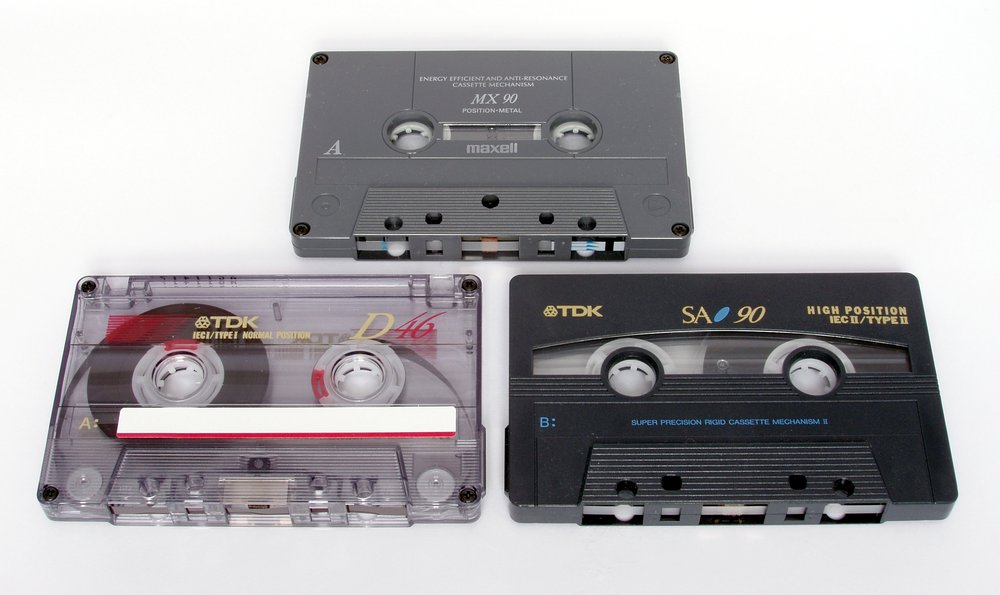
Invented by Lou Ottens at Philips in 1963, the cassette democratised music. Running at 1⅞ ips on a 0.15" ribbon with Type II Chrome tape and Dolby B noise reduction, it created mixtape culture and the 1979 Sony Walkman portable boom.

Landmark Audio Recording Dynamic Operatic Rock on Cassette
YouTube ↗
"Bohemian Rhapsody" (A Night at the Opera • 1975 Cassette Era)
Queen
A-Level Component 3 Critical Ear-Training Benchmark
Ear-Training Diagnostic: Tape Speed Limitations & Dolby Hiss
  • Listen to Freddie Mercury's delicate piano and a cappella vocal intro. Running at just 1⅞ inches per second on a narrow 0.15-inch ribbon, cassettes have a narrower dynamic range (~50 dB unassisted) and higher inherent tape hiss.
  • Listen to how Dolby B and C noise reduction suppress high-frequency hiss during quiet passages. If a cassette deck's playback head azimuth is misaligned, notice how the treble becomes dull, muffled, or suffers from high-frequency 'breathing'.
Philips 19631⅞ ips SpeedType I / II / IVDolby B / C NRSony Walkman
Format Architecture Audio Cassette Tape Formulations
Compact Cassette Tape Types
📼 Philips Compact Cassette (1963–Present)
1⅞ ips (4.76 cm/s) • 0.15" Tape • 4-Track Stereo (2 Tracks Per Side)
From Voice Dictation to Personal Stereo Revolution

Philips made the brilliant strategic decision to license the cassette patent royalty-free in 1965, defeating proprietary formats. In 1979, Sony's Walkman TPS-L2 turned music into a personal, mobile soundtrack for the first time in history.

Cassette engineering conquered severe physics constraints: tape running at only 1⅞ ips (one-eighth the speed of studio 15 ips tape) through tiny record heads required advanced magnetic chemistry and active compander noise reduction.

Cassette Formulations & Dolby Processing
1
Type I (Normal Bias / Ferric Oxide Fe2O3): Standard consumer tape, 120 µs equalization; warm sound but prone to higher background hiss and limited treble headroom.
2
Type II (High Bias / Chromium Dioxide CrO2): Requires 70 µs EQ; finer magnetic particle distribution provides extended high-frequency response and 4-5 dB lower noise floor.
3
Type IV (Metal Particle / Pure Iron): Microscopic pure metal particles deliver extraordinary magnetic coercivity and maximum dynamic headroom (+6 dB over Type I).
4
Dolby B / C Compander Noise Reduction: Boosts low-level high frequencies during recording, and attenuates them identically during playback, cutting audible tape hiss by 10 dB (Dolby B) or 20 dB (Dolby C).
Format 03 • Optical Digital

Compact Disc (CD-DA): Red Book & 16-Bit / 44.1 kHz

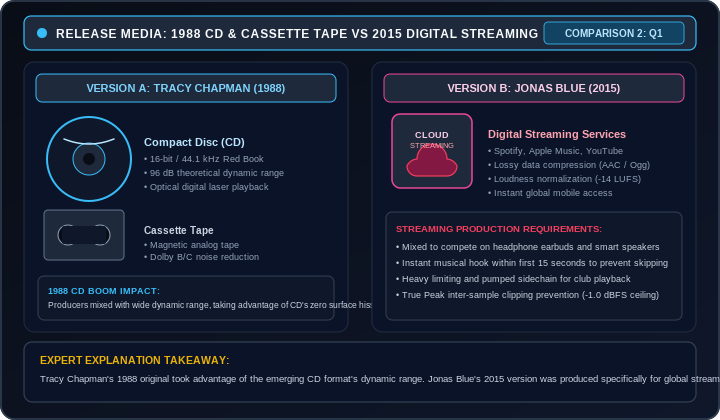
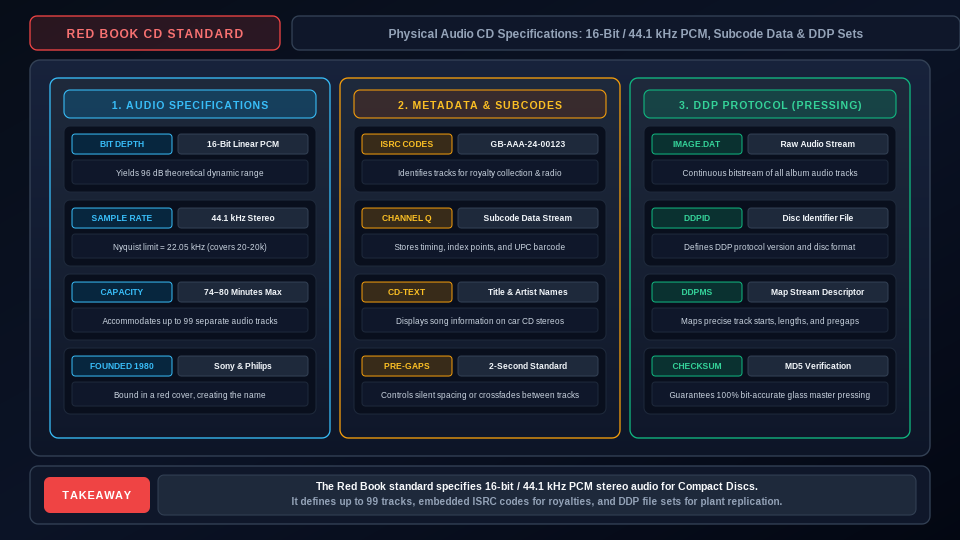
Co-developed by Sony and Philips in 1980 and released commercially in 1982, the CD replaced mechanical styluses with a semiconductor laser reading binary pits beneath clear polycarbonate, delivering 96 dB of silent dynamic range.

Landmark Audio Recording The First All-Digital CD Master Bestseller
YouTube ↗
"Money for Nothing" (Brothers in Arms • 1985 DDD CD Master)
Dire Straits
A-Level Component 3 Critical Ear-Training Benchmark
Ear-Training Diagnostic: Inky Digital Silence & Razor Transients
  • Listen to Sting's intro falsetto ('I want my MTV') over atmospheric synthesisers: there is absolute, pitch-black silence—zero vinyl crackle, zero tape hiss, zero wow and flutter, and a flat 20 Hz – 20,000 Hz frequency response.
  • Listen to Neil Dorfsman's recording of Omar Hakim's snare drum attack: the 16-bit linear PCM format preserves razor-sharp transient peaks without tape compression, providing over 90 dB of pristine signal-to-noise ratio.
Red Book 198244.1 kHz / 16-bitPits & Lands780nm Laser96 dB Dynamic Range
Format Architecture Optical CD Track & Pit Geometry
Red Book CD Pit Architecture
💿 Compact Disc Digital Audio (CD-DA • 1982)
120 mm Disc • 44.1 kHz / 16-Bit Linear PCM • 780 nm Infrared Laser Pickup
The Sony-Philips Red Book Standard

In 1980, Sony (Norio Ohga) and Philips (Kees Schouhamer Immink) established the 'Red Book' standard. They decided on 16-bit linear PCM resolution and a 44.1 kHz sampling rate, enabling a 120 mm disc to hold up to 74 minutes of music.

Brothers in Arms by Dire Straits (1985) was recorded on a 24-track Sony PCM-3324 digital tape recorder (DDD: Digital recording, Digital mixing, Digital mastering) and became the first CD to sell over 1 million copies.

How Optical Laser Transduction Works
1
Polycarbonate Disc with Pits & Lands: Audio data is pressed as a spiral track of microscopic depressions ('pits') and flat reflective surfaces ('lands') coated with vaporised aluminium and protective lacquer.
2
Semiconductor Laser Pickup (780 nm): An infrared semiconductor laser diode projects a focused 780 nm beam through the clear polycarbonate underside onto the aluminium layer.
3
Destructive Phase Cancellation: Pits are exactly 1/4 the laser's wavelength deep (~0.11 µm). Light reflecting from a pit cancels out light from the land, dropping reflected intensity detected by a photodiode.
4
CIRC Error Correction & DAC: Cross-Interleaved Reed-Solomon Code (CIRC) reconstructs up to 4,000 consecutive missing bits (scratches); the digital bitstream feeds a DAC to output analogue audio.
Format 04 • Perceptual Digital

MP3 & Streaming: Psychoacoustics & LUFS Targets

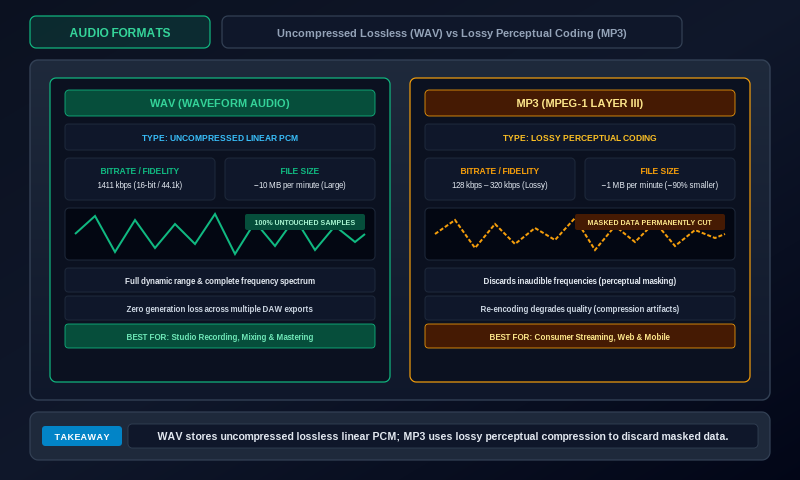
MP3 (1993) shrunk CD files by 90% using psychoacoustic masking to discard sounds human ears cannot perceive. Today, platforms like Spotify and Apple Music stream AAC and Ogg Vorbis while enforcing LUFS loudness normalisation.

Landmark Audio Recording The MP3 Reference Benchmark
YouTube ↗
"Tom's Diner" (1987 A Cappella • The Mother of the MP3)
Suzanne Vega
A-Level Component 3 Critical Ear-Training Benchmark
Ear-Training Diagnostic: Low-Bitrate Lossy Compression Artifacts
  • Listen to Suzanne Vega's isolated vocal: during algorithm development at Fraunhofer IIS, subtle breathing, vocal fry, and dental sibilance ('t', 's', 'k') exposed flaws in early MP3 encoders, causing harsh fluttering distortions.
  • Ear-training tests for lossy compression: (1) Metallic, watery 'swishing' on cymbals and high-hats, (2) Pre-echo: a faint 'ghost' transient audible milliseconds before sharp drum hits, (3) Steep low-pass filter cutting off frequencies above 16 kHz (128 kbps), and (4) Loss of stereo depth.
MPEG-1 Layer IIIPsychoacoustic MaskingTemporal Masking-14 LUFS Spotify-1 dBFS True Peak
Format Architecture WAV vs MP3 Data Architecture
WAV vs MP3 Compression Diagram
📱 MP3 & Streaming Audio (1993–Present)
Sub-Band MDCT • Psychoacoustic Masking • -14 LUFS Integrated Normalisation
From Fraunhofer Lab to Global Cloud Streaming

Uncompressed CD audio requires ~10 MB of data per minute (1,411 kbps). The Fraunhofer Society engineered MP3 using human hearing biology: if the brain can't hear a sound, don't store it! Today, Spotify (Ogg Vorbis 320k) and Apple Music (AAC 256k / ALAC Lossless) dominate global listening.

Streaming platforms also ended the 'Loudness Wars' by applying ITU-R BS.1770 / EBU R128 loudness normalisation (Spotify -14 LUFS, Apple -16 LUFS), penalising over-compressed squashed masters by turning them down automatically.

How Psychoacoustic Masking & Streaming Work
1
Simultaneous Frequency Masking: A loud sound at 1 kHz physically excites the basilar membrane in the inner ear, rendering quieter adjacent frequencies (e.g., at 1.1 kHz) completely imperceptible.
2
Temporal Masking (Pre- & Post-Masking): A loud snare transient temporarily deafens human hearing for ~5 ms before the hit (pre-masking) and up to 100 ms after (post-masking); quiet sounds within this window are discarded.
3
Sub-Band MDCT Filtering: Audio is split into 32 frequency sub-bands using Modified Discrete Cosine Transform (MDCT); quantization bits are allocated strictly to audible frequency bands.
4
Streaming Normalisation & True Peak (-1.0 dBFS): Spotify normalizes to -14 LUFS; mastering engineers leave -1.0 dBFS True Peak headroom to prevent inter-sample clipping during lossy codec reconstruction.
Component 3 Specification Matrix

The 4 Core Consumable Formats: Master Matrix

The complete Edexcel Component 3 comparative reference for the 4 syllabus formats: physical mediums, frequency bandwidths, dynamic ranges, and signature exam pitfalls.

Landmark Audio Retrospective Evolution of Sound Distribution
YouTube ↗
From Vinyl Grooves to Cloud Streams • A-Level Exam Master Review
Recording Industry Retrospective
Evolution of Commercial Sound Distribution
Ear-Training Diagnostic: Identifying Artifacts in Context 3 Exams
  • In Section A and B of Component 3, you may be presented with recordings and asked to identify the medium or audio flaw. Train your ears for: (1) Surface ticks & RIAA warmth = Vinyl, (2) Tape hiss & soft saturation = Cassette, (3) Inky black silence & sharp transients = Compact Disc, (4) Watery swishing & pre-echo = Low-bitrate MP3.
  • Use the Master Matrix table on the right to memorize exact bandwidths, dynamic ranges, and engineering terminology required by examiners.
Top 5 Edexcel Component 3 Exam Traps
1
Sample Rate vs Bit Depth Confusion: Sample Rate controls frequency bandwidth (Nyquist limit fs >= 2fmax). Bit Depth controls dynamic range and quantization noise floor (6.02 x N dB). Do not mix these up!
2
RIAA Equalisation Direction: Remember RIAA applies BOTH on cutting (bass cut, treble boost) AND on playback in the phono preamp (bass boost, treble cut to restore flat frequency balance and cut hiss).
3
Dolby B vs Dolby C Companding: Dolby B provides ~10 dB of high-frequency noise reduction; Dolby C provides ~20 dB. Both boost highs on record and cut highs equally on playback.
4
Lossy vs Lossless Distinction: MP3 and AAC are LOSSY (perceptual data is permanently discarded). WAV, AIFF, and FLAC are LOSSLESS (every single sample bit is preserved perfectly).
5
Loudness Normalisation Penalty: Streaming platforms measure Integrated LUFS. Mastering a track louder than -14 LUFS does NOT make it louder on Spotify—it gets turned down, losing punch.
Component 3 MatrixExam PitfallsLUFS TargetRIAA CurveNyquist Theorem
Specification Review The Format Specification Matrix
Formats Comparison Diagram
🏆 The Master Specification Matrix
4 Consumable Formats • Transduction Physics • Dynamic Range • Exam Traps
Edexcel Component 3 Examination Essentials

When answering questions on storage formats, always use technical terminology: 'Polyvinyl chloride', 'RIAA pre-emphasis/de-emphasis', 'Semiconductor laser photodiode phase cancellation', 'Type II Chromium dioxide', 'Psychoacoustic frequency and temporal masking', and 'ITU-R BS.1770 LUFS normalisation'.

Examiners frequently test your ability to explain WHY a technology was developed: e.g., why vinyl replaced shellac (longer playing time, quieter surface, lighter tracking), why RIAA was necessary (preventing physical groove overlap), or why MP3 compression was created (internet bandwidth limitations).

Format Transduction Method Bandwidth Dynamic Range Key Flaws & Exam Clues
Vinyl Disc (33⅓ & 45) Mechanical diamond stylus / PVC / RIAA phono pre-emphasis & de-emphasis 20 Hz – 20,000 Hz ~55–65 dB RIAA EQ curve needed, inner-groove distortion, wow & flutter, dust clicks, physical stylus wear.
Compact Cassette Magnetic induction / 0.15" tape at 1⅞ ips / Type I/II/IV / Dolby B/C NR 30 Hz – 16,000 Hz (Type II) ~50–65 dB (w/ Dolby) High tape hiss without Dolby B/C, head azimuth misalignment muffles treble, wow & flutter.
Compact Disc (CD) Optical 780 nm infrared laser / reflective pits & lands / 16-bit 44.1 kHz PCM 20 Hz – 20,000 Hz (flat) ~96 dB (16-bit) Red Book standard; zero surface noise or wow/flutter, CIRC error correction for scratches.
MP3 & Streaming Perceptual psychoacoustic coding / MDCT / LUFS loudness normalisation 20 Hz – 16 kHz (128k) / 20k (320k) Up to 96 dB (perceived) Auditory masking, metallic cymbal swishing, pre-echo transients, squashed masters turned down by LUFS.