The Synthesizer: Component 3 Syllabus Matrix
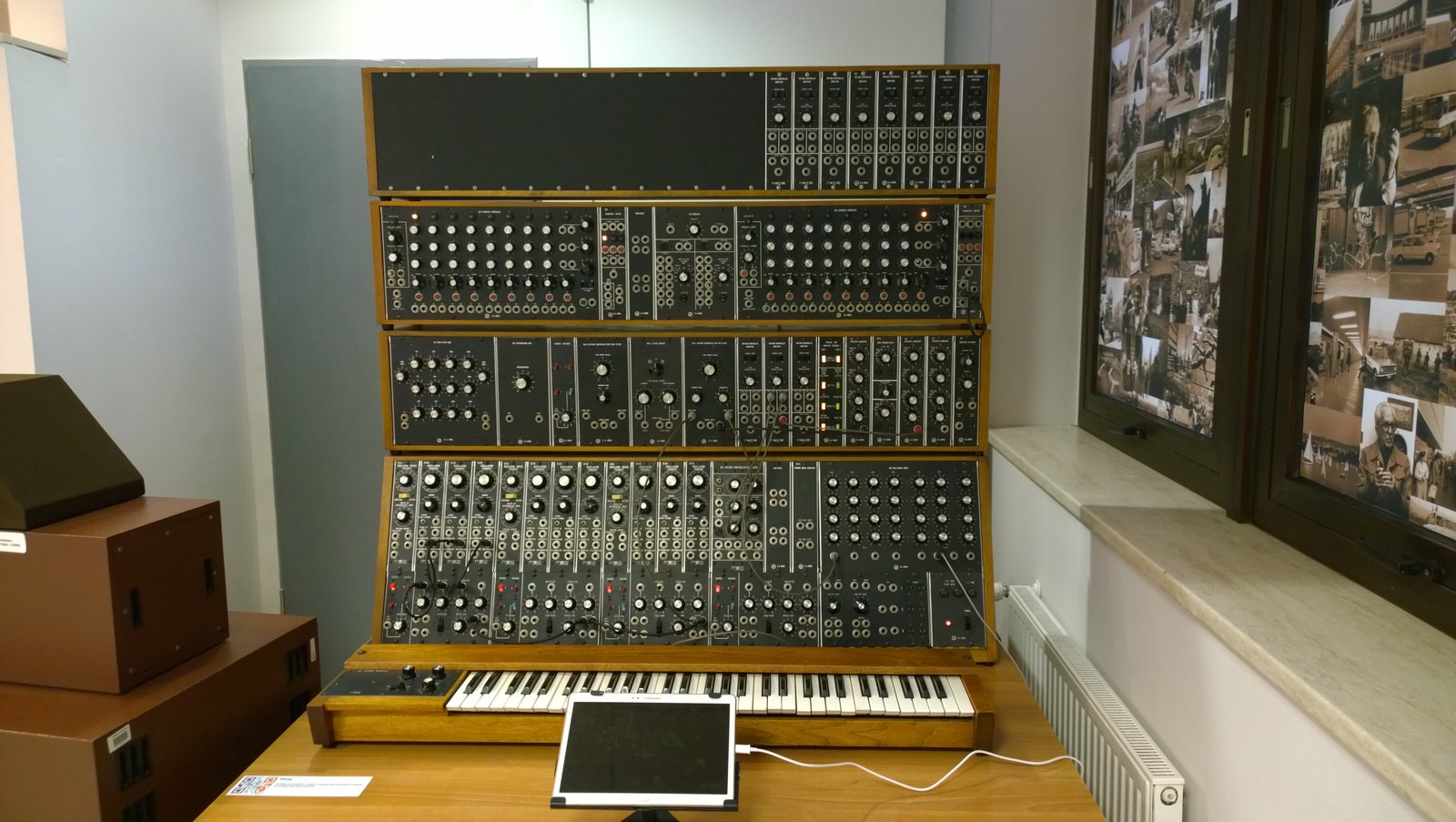
Modular Foundations (1960s)
Robert Moog and Don Buchla established voltage-controlled modular synthesis. Wendy Carlos proved synths as musical instruments with Switched-On Bach (1968).
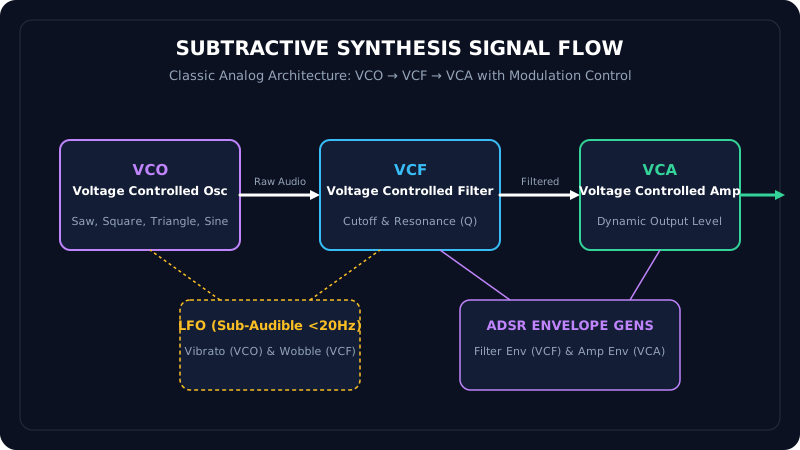
Subtractive Architecture
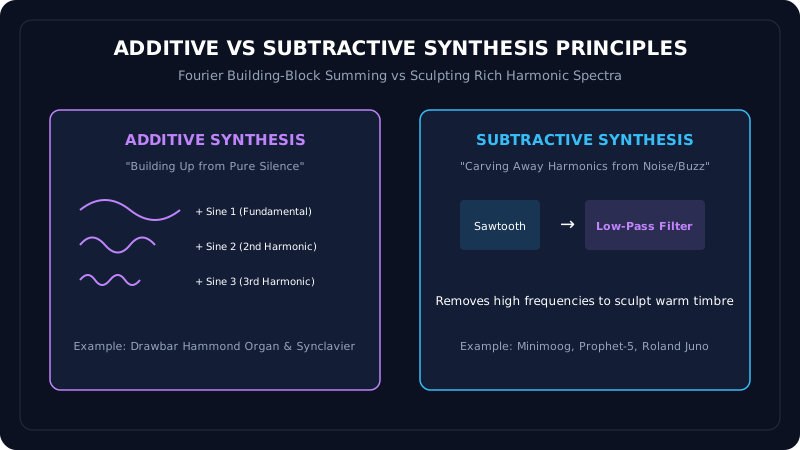
Raw harmonic spectra generated by Voltage Controlled Oscillators (VCOs) are dynamically sculpted by Voltage Controlled Filters (VCF) and amplified via VCAs with ADSR envelopes.
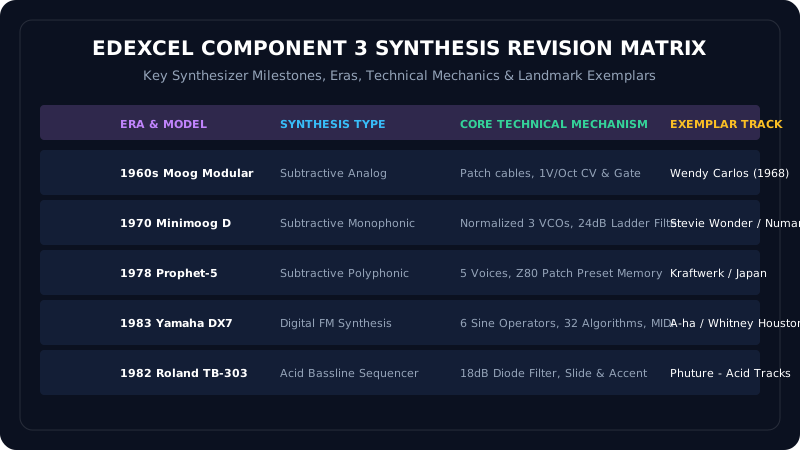
Polyphony, FM & MIDI (1980s)
The transition from monophonic leads to 5-voice patch memory (Prophet-5), Yamaha DX7 FM digital synthesis, and the universal MIDI 1.0 serial protocol (1983).
Oscillators (VCO): Harmonic Spectra & Raw Timbre
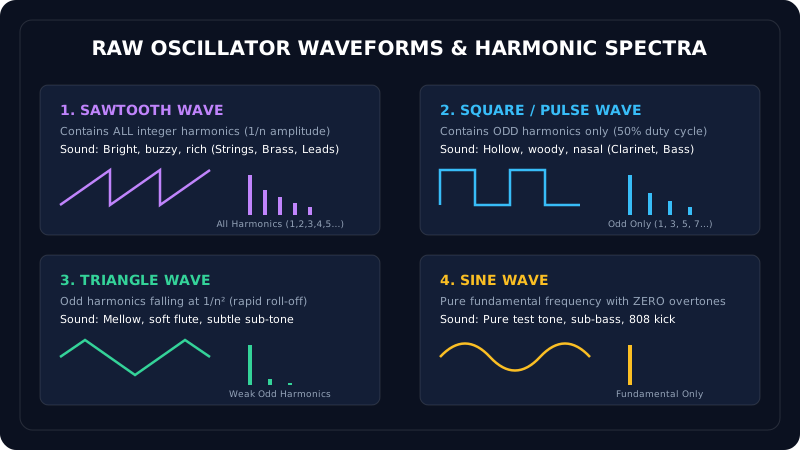
Sawtooth: All Harmonics
Contains all integer harmonics (1, 2, 3, 4, 5...) with amplitude falling at 1/n. Produces a bright, buzzy timbre essential for brass, strings, and rich synth leads.
Square & Pulse: Odd Harmonics
A symmetrical square wave contains odd harmonics only (1, 3, 5, 7...). Modulating pulse width (PWM) introduces shifting chorused partials perfect for hollow woodwinds and fat basses.
Multi-VCO Detuning & Beats
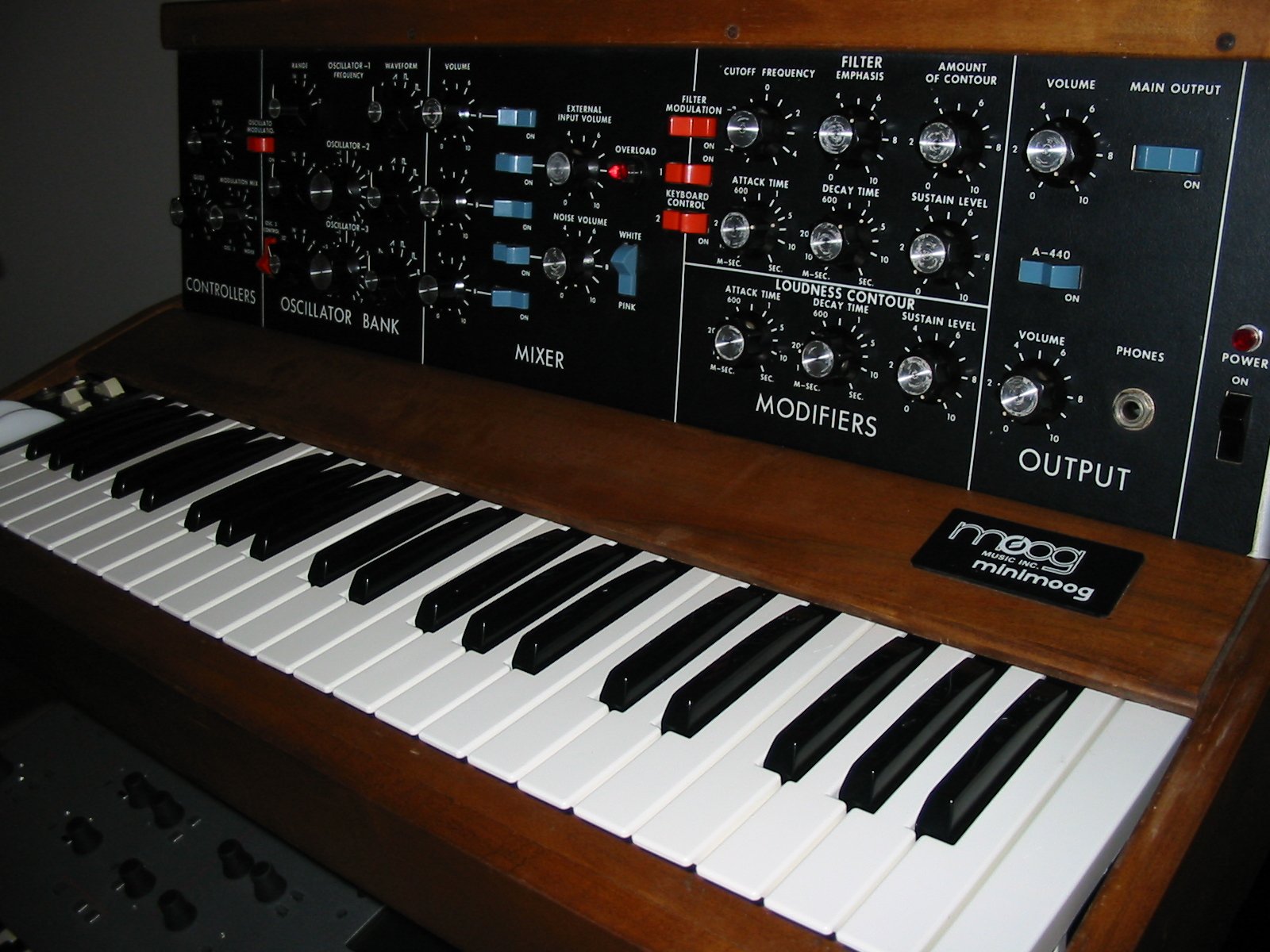
Combining two or three oscillators with slight micro-tuning differences produces acoustic phase beating, creating the massive, thick stereo chorusing characteristic of the Minimoog.
The VCF: Cutoff Frequency, Resonance & Ladder Circuits
Low-Pass Filter & Cutoff (fc)
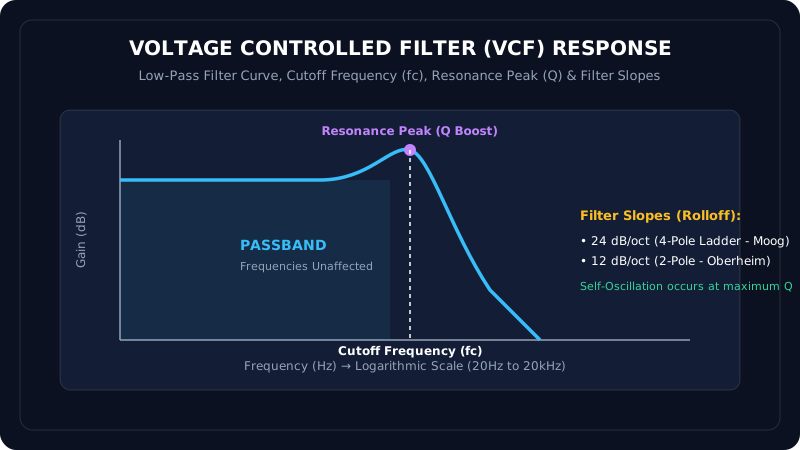
A Low-Pass Filter (LPF) allows frequencies below the cutoff frequency to pass while attenuating higher overtones, warming the sound and softening aggressive upper harmonics.
Resonance (Q) & Self-Oscillation
Feedback routed from the filter output back to the input creates a resonant peak at the cutoff point. At extreme resonance settings, the filter produces a pure self-oscillating sine wave.
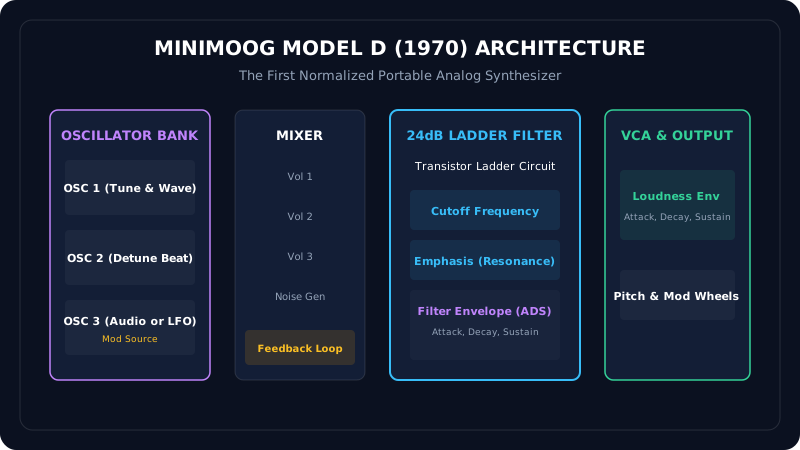
24 dB/Octave Ladder Filter
Bob Moog's patented 4-pole transistor ladder filter provided a steep 24 dB/octave rolloff with non-linear saturation, delivering the warm, musical low-end drive of classic records.
Envelopes: 4-Stage ADSR Shaping of VCF & VCA
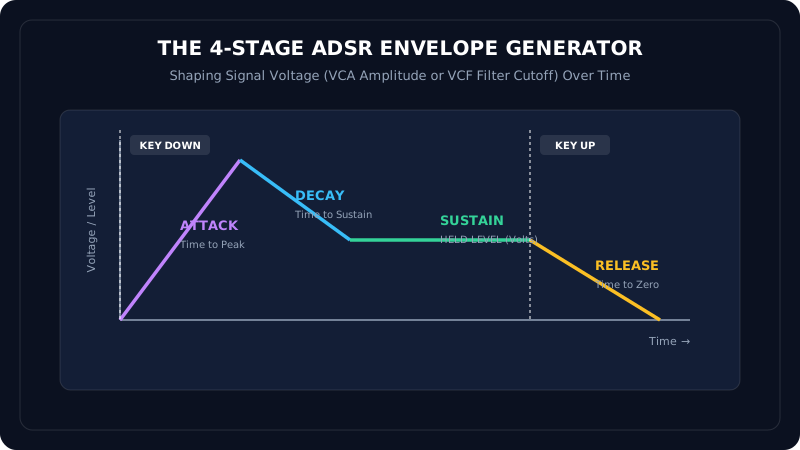
The 4 Envelope Stages
Attack Time: Duration to peak. Decay Time: Duration to drop to sustain. Sustain Level: Held voltage level. Release Time: Fade to zero on key release.
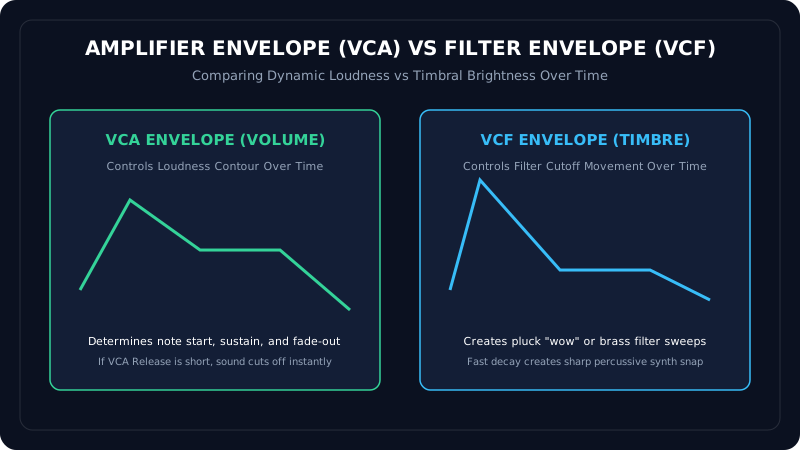
Filter Env vs Amp Env
The VCA Envelope controls loudness over time, while the VCF Envelope modulates filter cutoff, creating brassy opening sweeps or percussive pluck snaps.
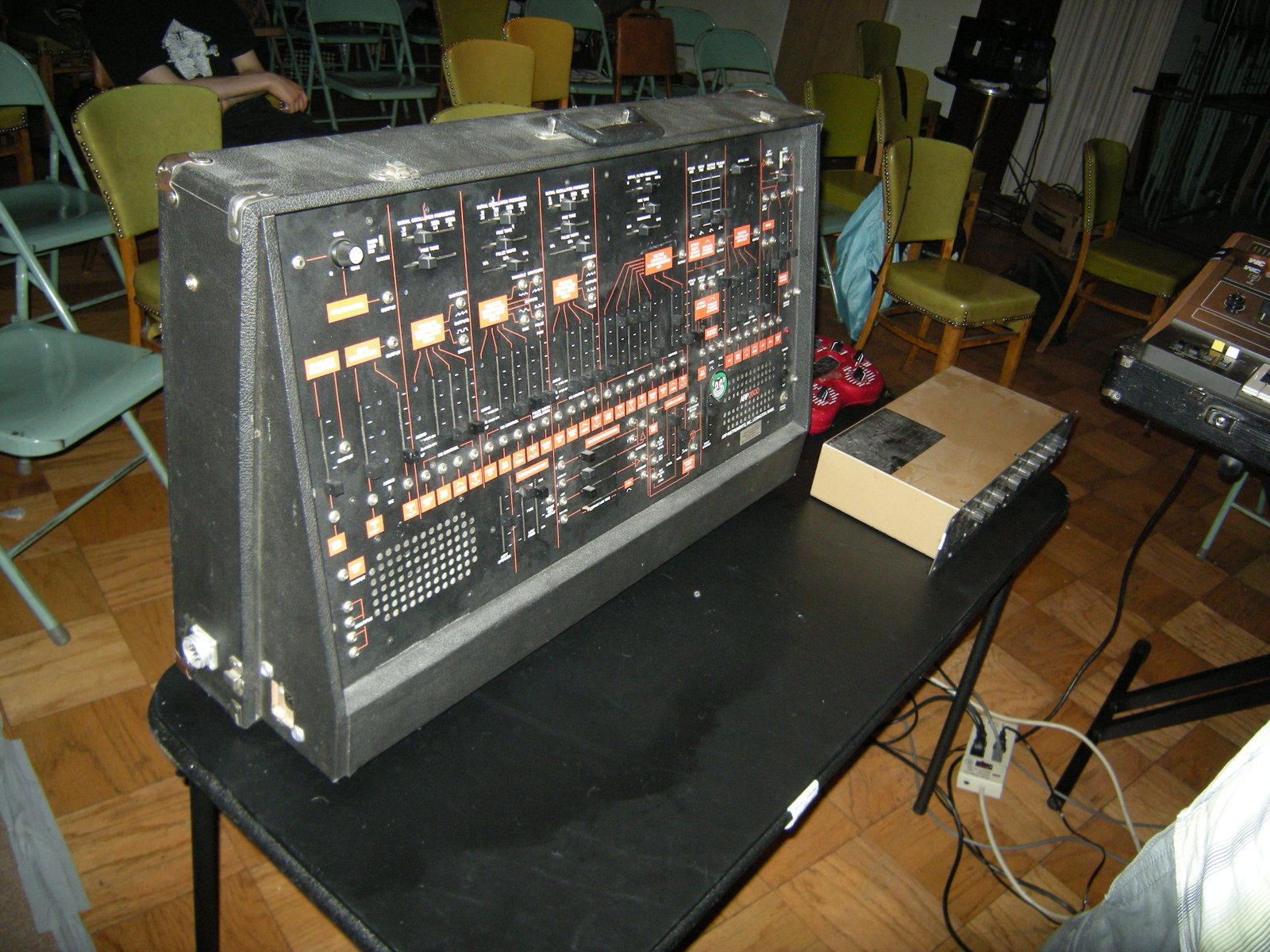
Transient Attack Shaping
Instantaneous attack times (<1 ms) produce sharp, percussive synth bass plucks, while slow attack times (200–800 ms) create ambient cinematic string swells and evolving pads.
LFO Modulation: Vibrato, Tremolo & Filter Sweeps
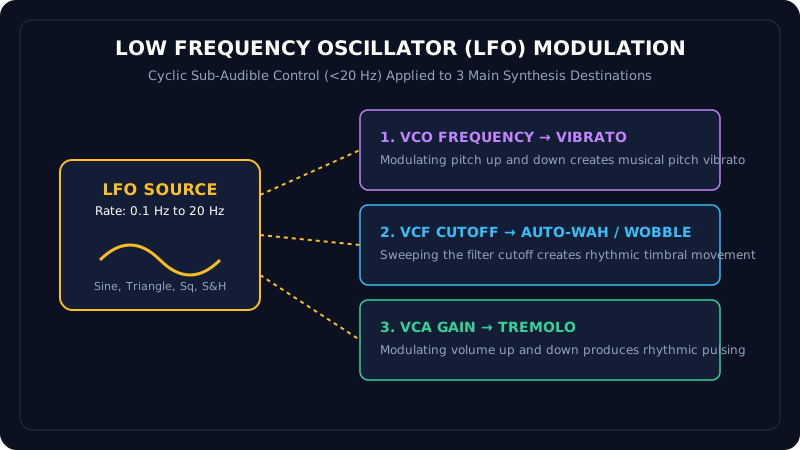
Three Primary Destinations
VCO Pitch: Musical pitch vibrato (5–7 Hz). VCF Cutoff: Wah-wah, rhythmic dubstep wobble, or filter sweeps. VCA Gain: Pulsing amplitude tremolo.
Pulse Width Modulation (PWM)
Modulating a pulse wave's duty cycle via a slow triangle LFO creates a lush, natural ensemble chorusing effect without requiring multiple physical oscillator circuits.
Sample & Hold (S&H)
By sampling white noise at regular clock intervals, Sample & Hold outputs random stepped voltages, creating the bubbling computer sci-fi effects heard in 1970s progressive rock.
Modular Era: CV, Gate & Patch Bay Logic
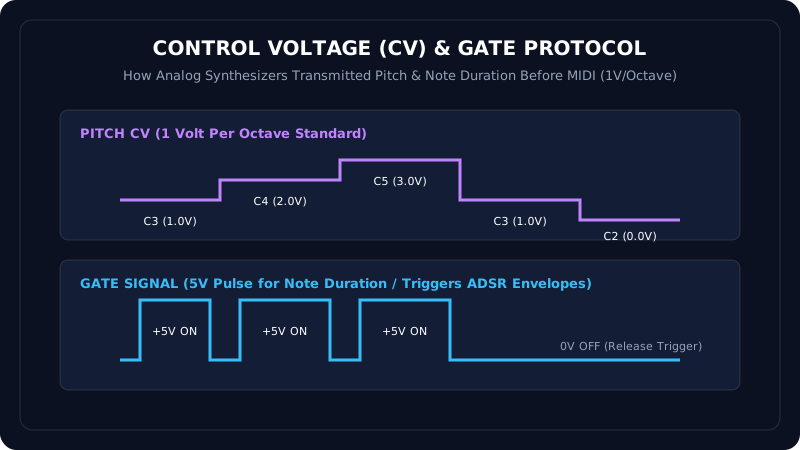
1 Volt Per Octave (1V/Oct)
Established by Bob Moog: increasing DC voltage by exactly 1.0V doubles the oscillator frequency, raising the musical pitch by one chromatic octave (0.0833V per semitone).
Gate & Trigger Pulses
Pressing a key outputs a +5V DC Gate pulse held for the note's duration, triggering the ADSR envelopes. Releasing the key drops the gate to 0V, initiating the Release phase.
Semi-Modular Normalization
The ARP 2600 (1971) hardwired common audio paths internally through slider switches, allowing instant playing while retaining patch jacks for overriding default connections.
The Minimoog Model D: The First Gigging Icon
Hardwired Normalization
Engineered by Bill Hemsath and Bob Moog, the Model D eliminated messy patch cords in favor of dedicated rotary switches, offering 3 stable VCOs and roadworthy road portability.
The Headphone Feedback Trick
Patching the headphone output back into the external audio input overrode the input buffer, overdriving the 24dB ladder filter to produce aggressive, harmonically saturated bass grit.
Stevie Wonder & TONTO
Stevie Wonder (Living for the City, Superstition) and Gary Numan (Are 'Friends' Electric?) established the Minimoog as the undisputed monarch of synth bass.
Prophet-5 (1978): Microprocessor Patch Memory
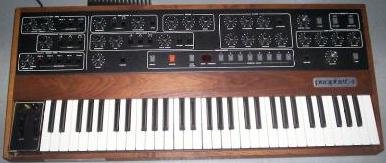
5-Voice Polyphony
Dave Smith packed 10 analog VCOs, 5 VCFs, and 10 ADSR envelopes into five internal voice cards, allowing keyboardists to play full 5-note harmonic chords for the first time.
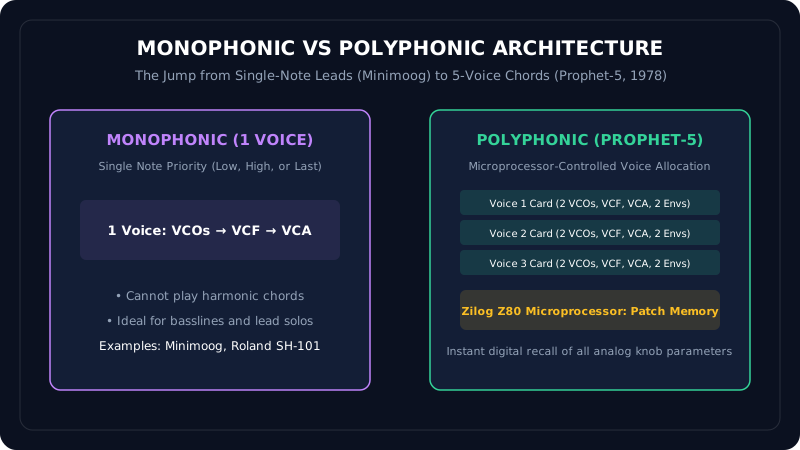
Zilog Z80 Patch Storage
An onboard microprocessor digitized knob positions into memory, allowing musicians to store 40 editable patches and recall them instantly on stage at the press of a button.
Kraftwerk & 1980s Pop
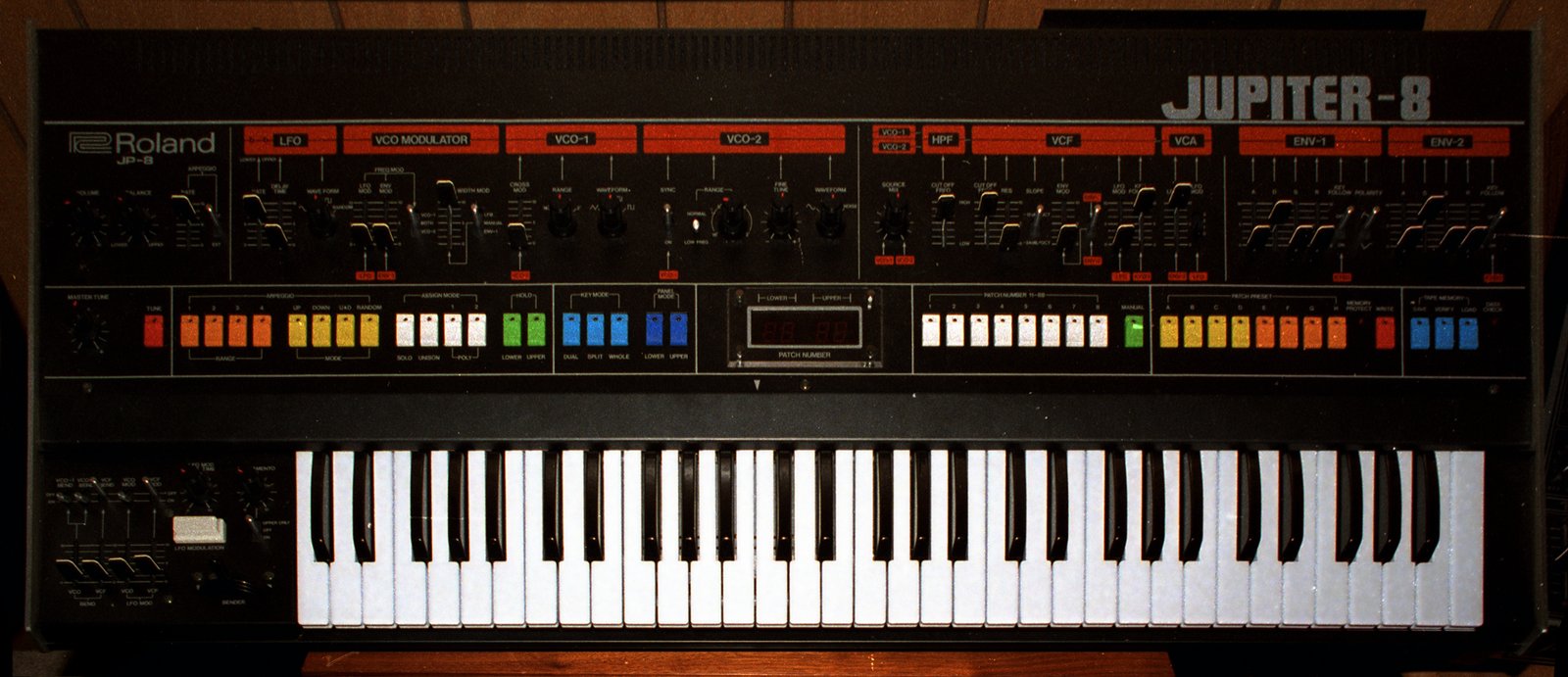
The Prophet-5 and Roland Jupiter-8 powered the signature synth-brass and lush string pads that replaced rock guitars in early electronic and new wave music.
Yamaha DX7 (1983): The Digital Sound of the 80s
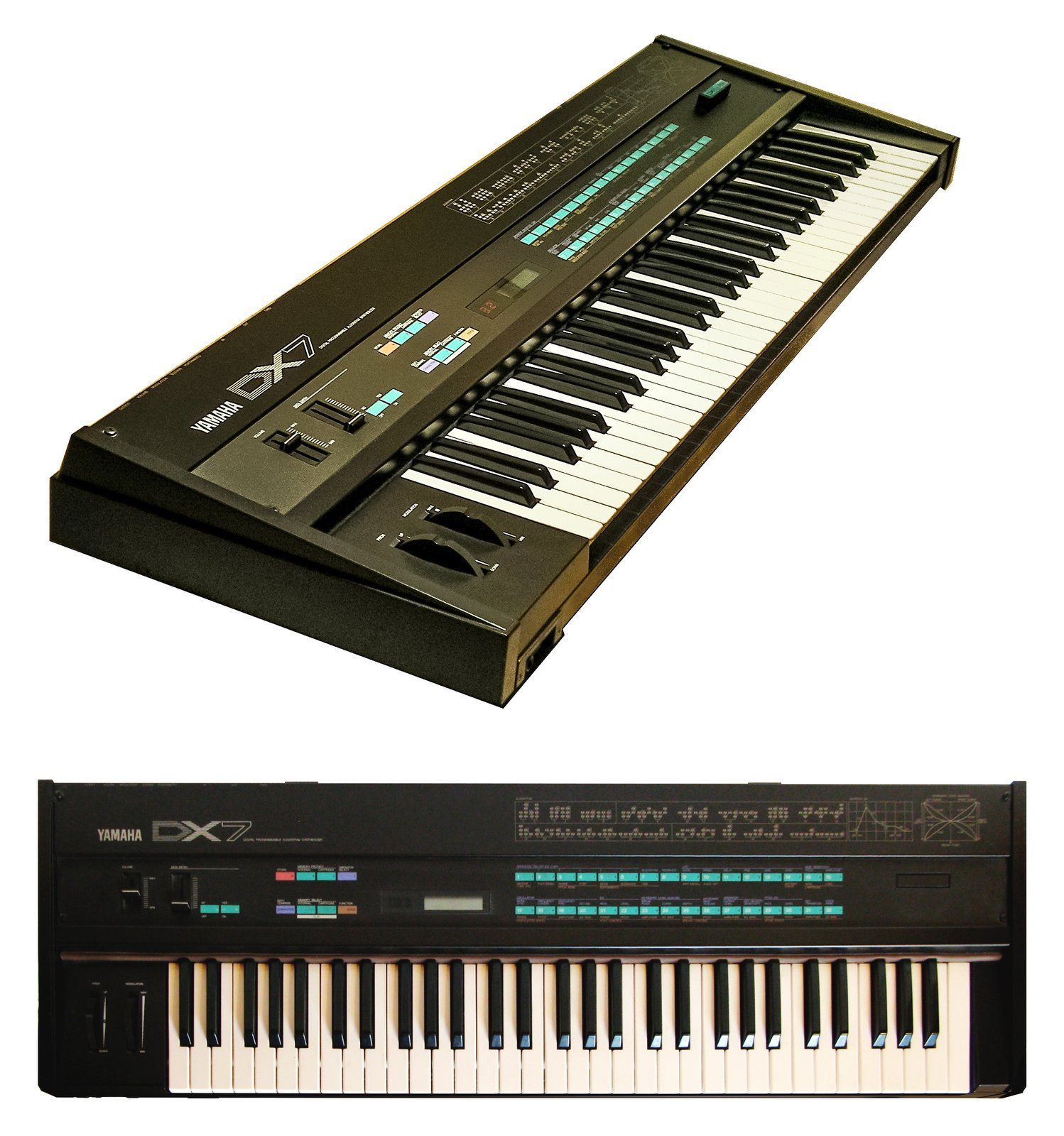
The DX7 Phenomenon
Selling over 200,000 units, the DX7 replaced analog warmth with crisp, glass-like digital clarity, dominating 1980s pop, power ballads, and commercial broadcasting.
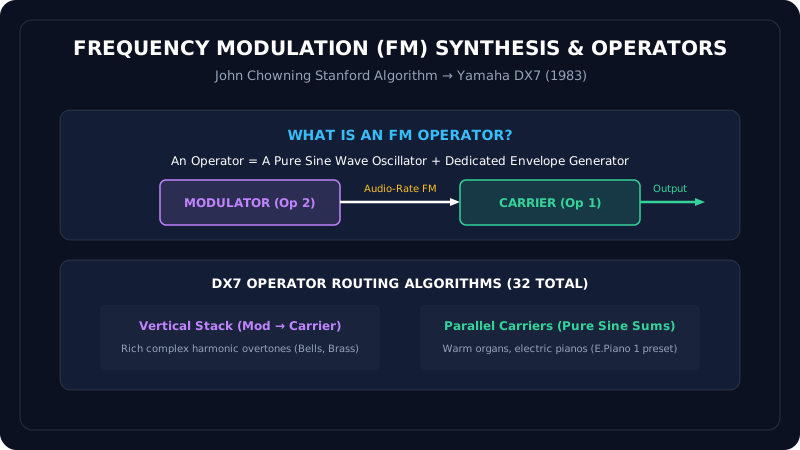
6 Operators & 32 Algorithms
Instead of filtering, 6 sine wave operators modulate each other's frequency at audio rates. The routing algorithm dictates whether an operator acts as a Carrier or Modulator.
A-ha & Digital Slap Bass
The bright, punchy DX7 powered iconic lead riffs like A-ha's Take On Me and provided pristine digital bells, glassy tines, and percussive slap bass lines.
MIDI 1.0 (1983): The Digital Communication Standard
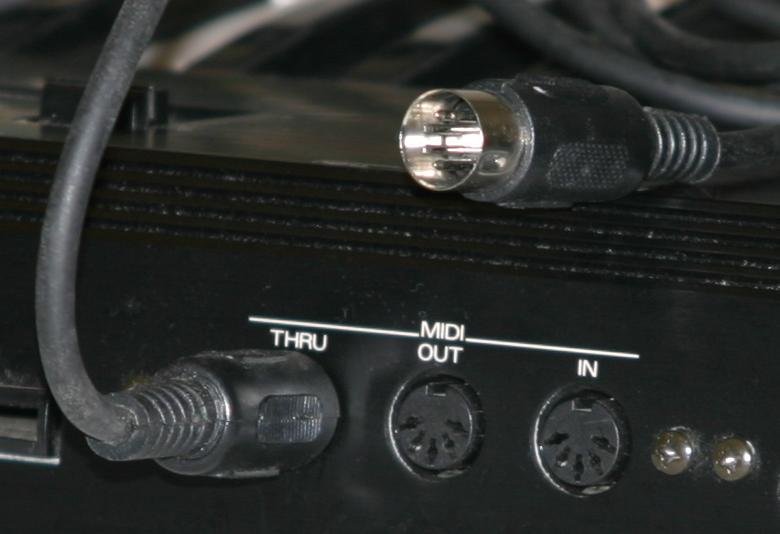
5-Pin DIN & 31.25 kbaud
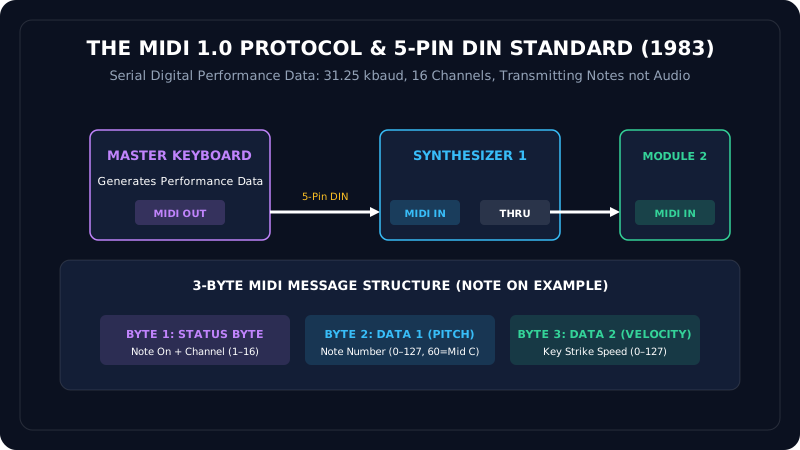
MIDI transmits digital performance instructions (not audio signals) over a 5-pin DIN cable at 31.25 kbaud, allowing hardware from rival manufacturers to communicate flawlessly.
Note On, Pitch & Velocity
Standard messages comprise 3 bytes: Status Byte (Note On/Channel), Data Byte 1 (Note Pitch 0–127), and Data Byte 2 (Key Velocity 0–127).
Hardware & Computer Sequencing
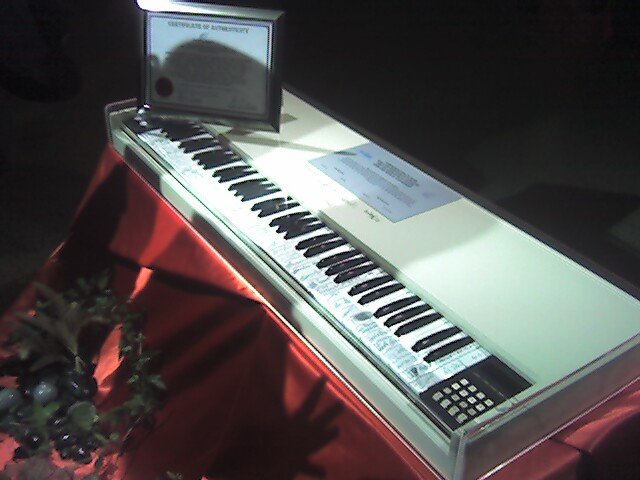
MIDI enabled multi-timbral computer sequencers (Atari ST, Cubase, Logic, Roland MC-500) to orchestrate entire synth ensembles, drum machines, and samplers with millisecond timing.
Roland TB-303: The Machine That Defined a Genre
Second-Hand Resurgence
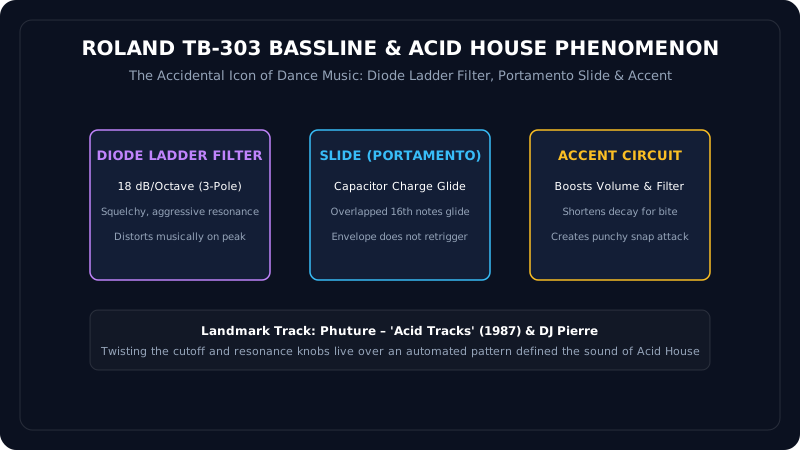
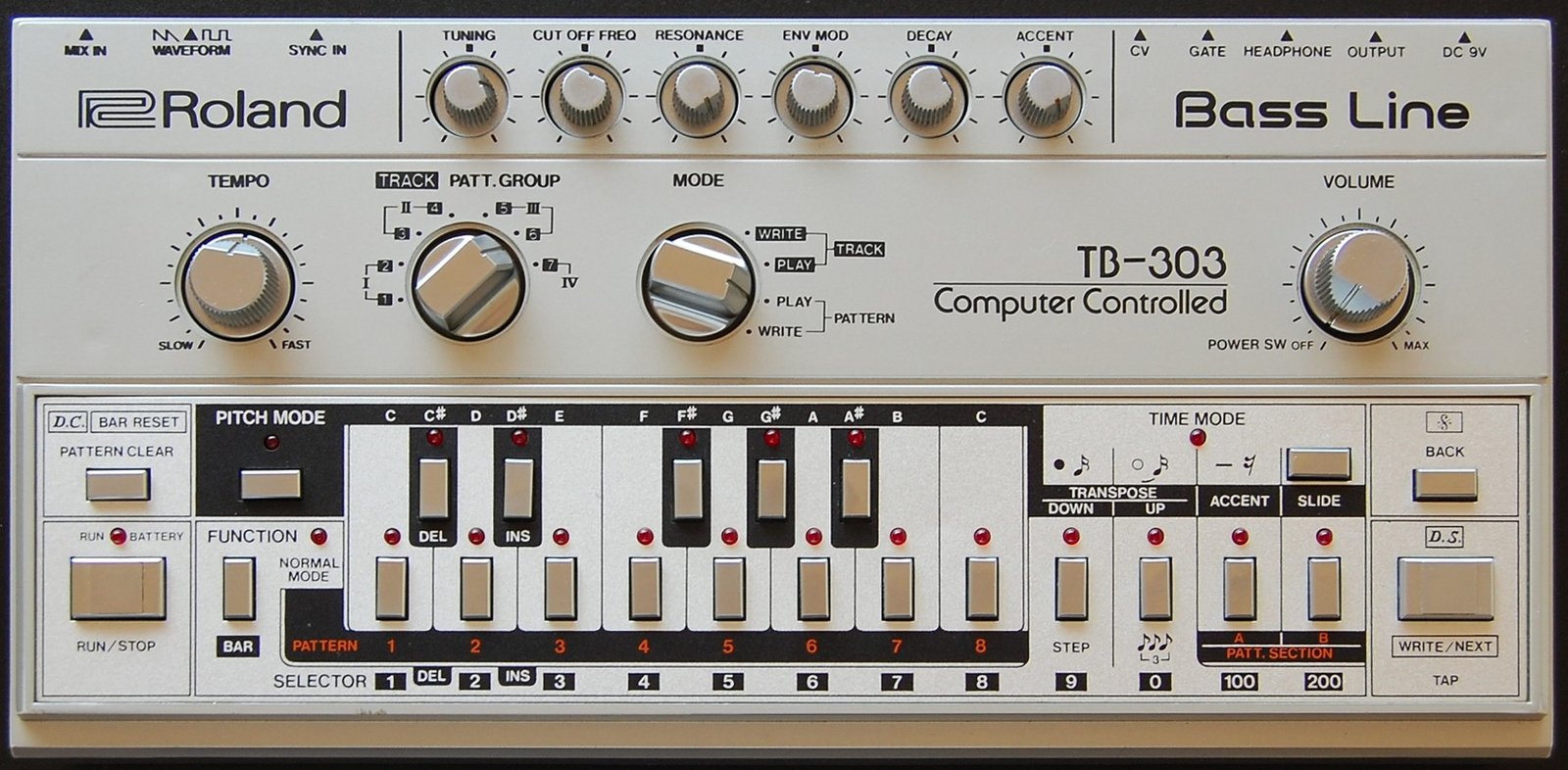
Discarded in pawn shops for under £50, Chicago producers like DJ Pierre (Phuture) picked up the 303 and experimented with turning knobs while running the internal 16-step sequencer.
18dB Diode Filter & Slide
The 18 dB/octave (3-pole) diode ladder filter produces an aggressive, squelchy resonance distortion. The Slide circuit glides pitch smoothly between notes without retriggering envelopes.
Chicago Acid House Genesis
Phuture's Acid Tracks (1987) and Frankie Knuckles established the TB-303 as the defining instrument of late-80s Chicago house and UK rave culture.
Wavetable & Sampling: Evolving Digital Textures
PPG Wave (1981) & Wavetables
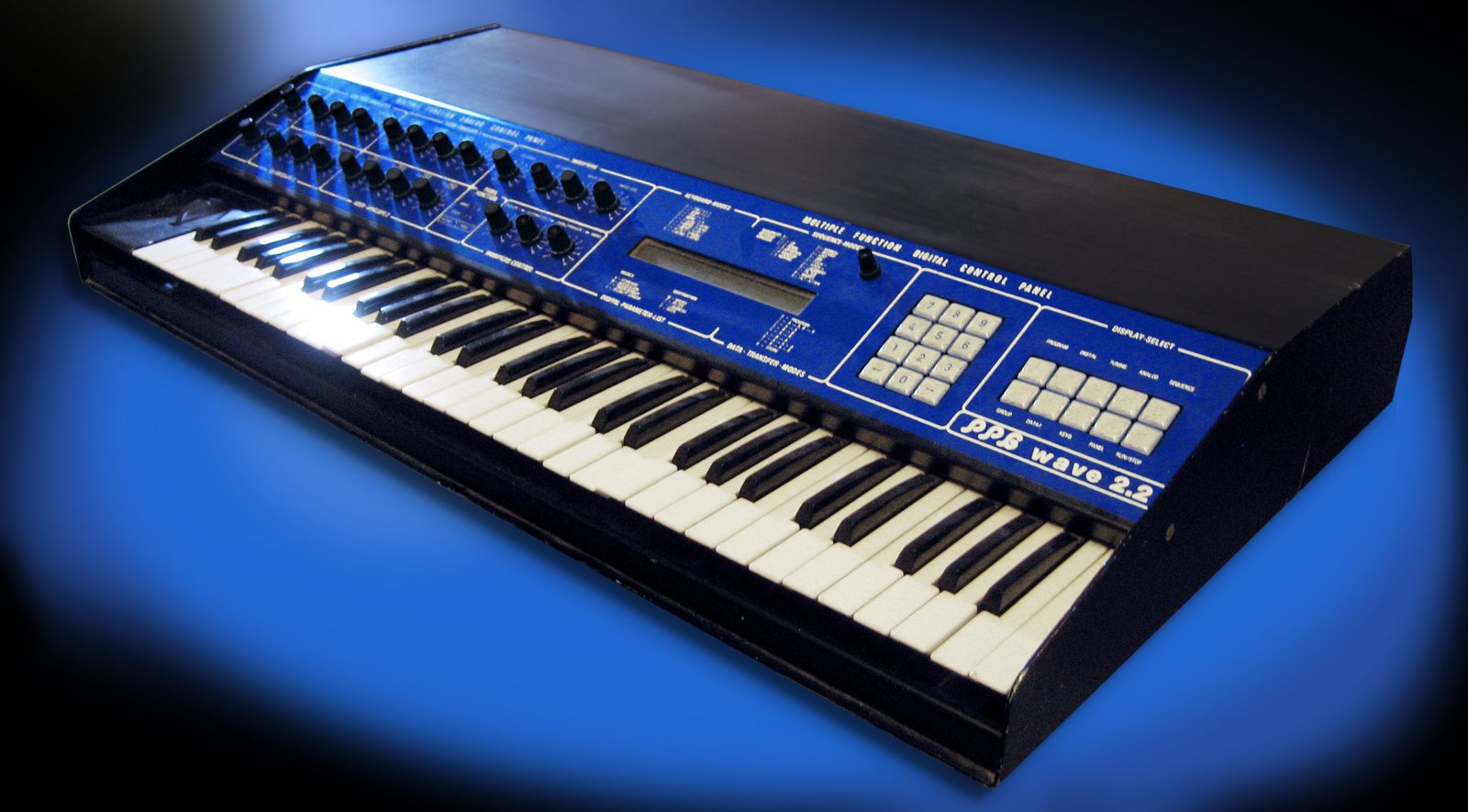
Engineered by Wolfgang Palm, wavetable synthesis scans through tables of single-cycle digital waveforms, feeding into warm analog VCF filters (Depeche Mode, Tears for Fears).
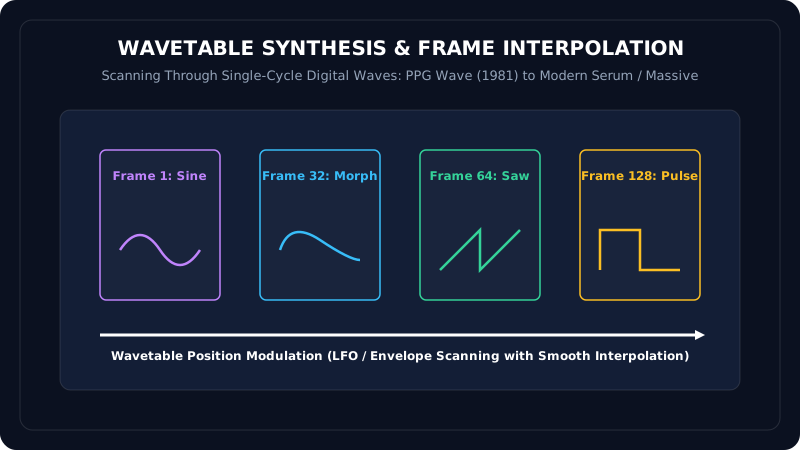
Frame Interpolation & The Hoover
Modulating wavetable position or utilizing Pulse Width Modulation (PWM) with heavy chorusing created iconic aggressive rave sounds (e.g. Roland Alpha Juno Hoover sound).
Sampling & Granular (Fairlight)
The Australian Fairlight CMI (1979) and E-mu Emulator recorded real acoustic instruments into RAM, bridging synthesis and realistic orchestral hits (Peter Gabriel, Kate Bush, Trevor Horn).
Listening Analysis: Landmark Synthesis Productions
Michael Jackson & Quincy Jones
Michael Jackson's Billie Jean / Thriller (produced by Quincy Jones) featured dual-tracked Minimoog synth bass layered with Roland Jupiter-8 brass pads for unrivaled low-end punch.
Gary Numan & Kraftwerk
Gary Numan's Are 'Friends' Electric? (1979) and Kraftwerk's The Robots (1978) established electronic synthesizers as commercial lead instruments over guitars.
A-ha – "Take On Me" (1984)
The infectious lead hook blends the Yamaha DX7 and Roland Juno-60, pairing digital FM transient brightness with warm analog chorused body for maximum radio presence.
Component 3 Strategy: Question 5 & Essay High Marks
Precision Technical Keywords
Always state exact parameters: specify 24 dB/octave low-pass cutoff, Q resonance emphasis, ADSR attack time, LFO modulation depth, and carrier/modulator ratio.
Hands-On Patch Design
Step-by-step masterclass demonstrating how filter envelope decay, resonance, and detuned dual oscillators shape signature dance and pop basslines.
Quantization & Sequencing Context
Explain how MIDI protocol allowed hardware sequencing, note quantization, velocity layering, and multi-timbral studio arrangements without multitrack tape generation loss.
Synthesis Mastery: Final Revision Checklist
Signal Flow Checklist
☑ VCO: Saw, Square/Pulse, Triangle, Sine
☑ VCF: Low-pass Cutoff & Resonance
☑ VCA: Amplitude Level
☑ ADSR: Attack, Decay, Sustain, Release
☑ LFO: Sub-audible pitch, filter & amp modulation
FM & MIDI Checklist
☑ John Chowning Stanford algorithm
☑ 6 Sine Operators & 32 Algorithms
☑ Carrier (output) vs Modulator (timbre)
☑ MIDI 1.0 (1983): 31.25 kbaud, 5-pin DIN
☑ Status Byte + 2 Data Bytes (Pitch, Velocity)
Key Hardware Timeline
• 1968: Moog Modular (Switched-On Bach)
• 1970: Minimoog Model D (Normalization)
• 1978: Prophet-5 (Polyphony & Patch Memory)
• 1982: TB-303 (Acid House 18dB Diode Filter)
• 1983: Yamaha DX7 & MIDI Protocol